
A Farewell to Arms
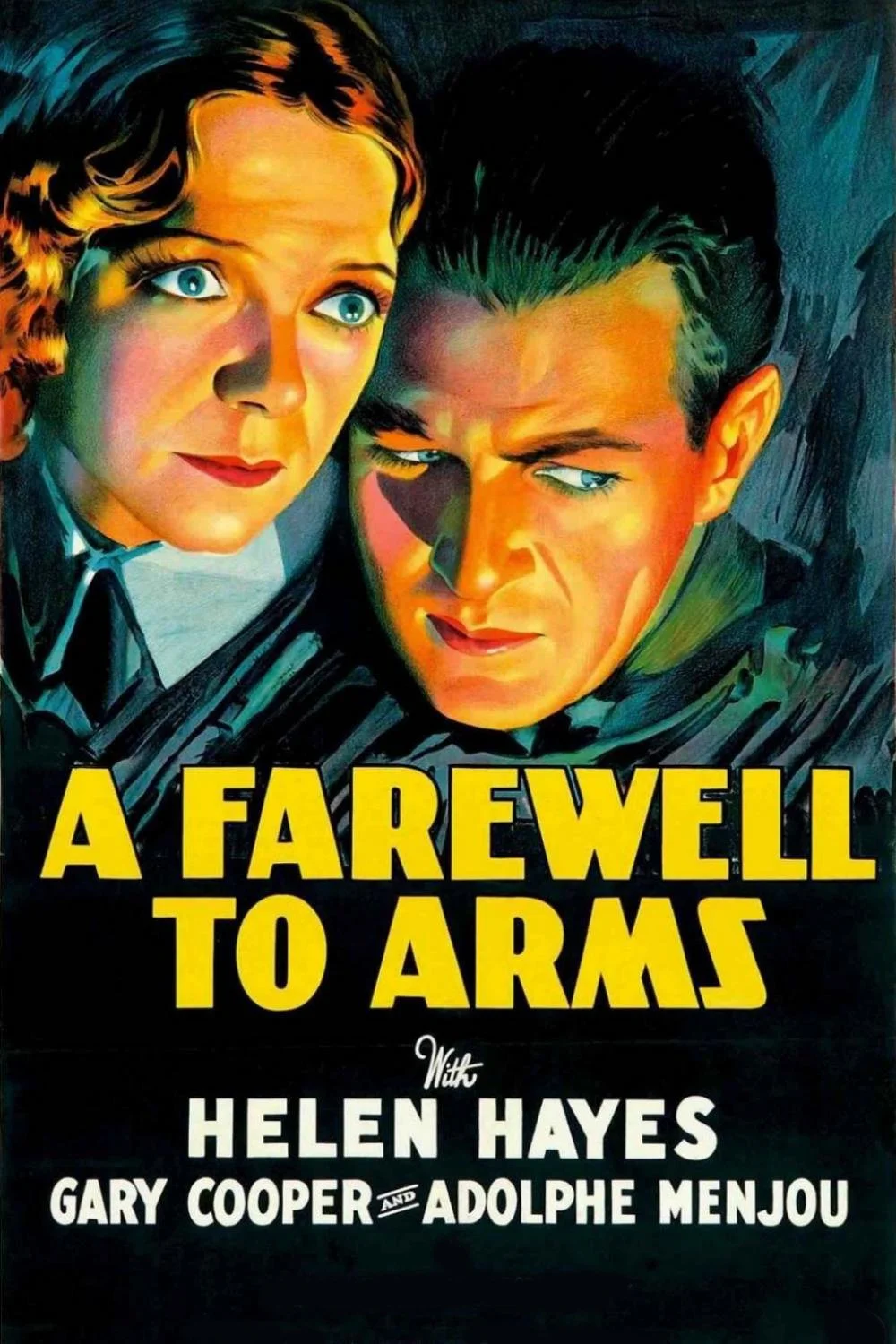
A Farewell to Arms
Directed by Frank Borzage. 80 mins. (1932)
Gary Cooper – Lieutenant Frederic Henry
An American ambulance officer serving in Italy during World War I falls deeply in love with a devoted British nurse, and together they struggle to find meaning and refuge amid the devastation and disillusionment of war.
Also starring Helen Hayes, Adolphe Menjou, Mary Philips, Jack La Rue, and Mary Forbes.
Based on Ernest Hemingway’s 1929 novel, the film was among the earliest serious Hollywood treatments of World War I romance and helped solidify Cooper’s image as a conflicted yet idealistic hero. It received four Academy Award nominations, winning for Best Cinematography and Best Sound, and was later remade in 1957 starring Rock Hudson and Jennifer Jones.
MARIA’S NOTES
It does seem like Gary Cooper and Ernest Hemingway were destined to meet and become friends, although A Farewell to Arms was made before those two men had ever encountered each other.
My father portrayed the protagonist Lieutenant Frederic Henry and his co-star Helen Hayes, the First Lady of the American theater, starred as love interest Catherine Barkley. The story takes place in war torn Italy in World War 1 and the two of them fall in love. In real life, Helen, by her own admission, became totally smitten by my father. She said “ …if only he had wiggled his finger at me to come meet him, I would have left my husband (the writer Charles McArthur) and child and run off with him.” She muttered this in between takes of one of their love scenes in the picture, looking adoringly into my father’s eyes. She recalled, “Gary looked back at me, took me firmly by my shoulders and said ‘NO, HELEN , NO.’” Nevertheless, they remained friends even though much of her acting life was still devoted to theater and she lived in New York City.
The studio shot 2 different endings for the film. The first was the Hemingway ending, faithful to the novel, in which Catherine dies in Frederic’s arms, and the second was the “Hollywood Ending” where she lives. The studio and distributors opted for the Hollywood ending at first, but later distributed the film internationally with the Hemingway ending where Miss Hayes dies in Cooper’s arms. In some cases at select American theaters, moviegoers could choose which ending they wanted to see.
When I met Miss Hayes for the first time, my husband and I were invited to visit her at her home in Nyack, New York. She greeted us at the front door and as she opened it, she saw me silhouetted by the sunlight outside. She exclaimed, “Oh, you look just like Gary standing there, tall and quiet.” It was a very emotional moment for me. I really did not know what to say and could only focus on the deep feelings running through me. After so much time, a connection was still there. She was as beautiful at the height of her career as she was when I met her––an angel.
Maria Cooper Janis