
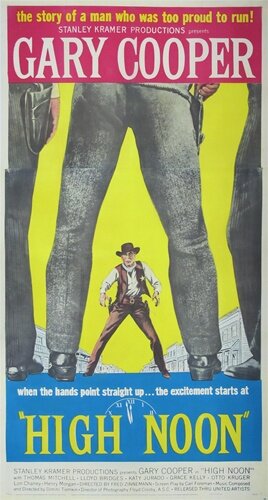
High Noon
High Noon
Directed by Fred Zinnemann. 85 mins. (1952)
Gary Cooper – Marshal Will Kane
Grace Kelly – Amy Fowler Kane
A retiring frontier marshal must face a vengeful outlaw and his gang alone when his town refuses to stand with him.
Also starring Thomas Mitchell, Lloyd Bridges, Katy Jurado, Otto Kruger, Harry Morgan, and Lon Chaney Jr.
Directed by Austrian-born filmmaker Fred Zinnemann, the film unfolds in real time and became one of the most acclaimed Westerns ever produced. Made for $750,000, it went on to gross over $8 million in the United States.
Ranked #27 on the AFI’s 100 Greatest American Films (2007) and #2 on the AFI’s 10 Greatest Westerns. Winner of four Academy Awards, including Best Actor (Gary Cooper), Best Score, Best Song, and Best Film Editing; nominated for Best Picture, Director, and Screenplay. Winner of the Writers Guild Award for Best Written American Drama and selected for preservation in the National Film Registry (1989).
MARIA’S NOTES
Nobody involved in the making of High Noon thought they were making more than just another, hopefully, good little Western which cost all of $750,000. It was not filled with the expected action of cowboys vs. Indians chasing each other across the plains. However, in the talented hands of several artists from the Writer Carl Foreman to Director Fred Zinnemann, to its star, my father, Gary Cooper, the beautiful ladies Grace Kelly and Katy Jurado, the sinister villains including Lee Van Cleef and the wonderful theme song composed by Dimitri Tiomkin, this “little Western” turned into an iconic film that has affected and touched world leaders from Japan to Poland and shook up American politics at the time of one of our more shameful periods – the McCarthy hearings. According to those hearings, there was a Communist under every bed. My father was extremely close to High Noon’s writer Carl Foreman, in fact, he called him Uncle Carl and when the film’s producer Stanley Kramer wanted to take him off the film because of alleged Communist propaganda, my father simply said, “If Foreman goes, Cooper goes.”
Many books and articles have been written about High Noon. The story exposed the cross currents buried in human nature and politics. We see in the film a reflection of our own inner conscience and its struggle between fear and doing what you know is right – to do what you have to do for a greater good, or in the name of justice – concepts which are not limited to any one era. In fact, there’s a very interesting parallel between High Noon and Ernest Hemingway’s The Old Man and the Sea – both challenge our own personal definitions of Honor, Courage, Justice and Fear. My father won an Academy Award for his portrayal of Marshal Kane. It was the first time the “hero” of a film was shown to be human and vulnerable.
I strongly recommend for further reading the recent book, High Noon: The Hollywood Blacklist and the Making of an American Classic by Glenn Frankel.
Maria Cooper Janis
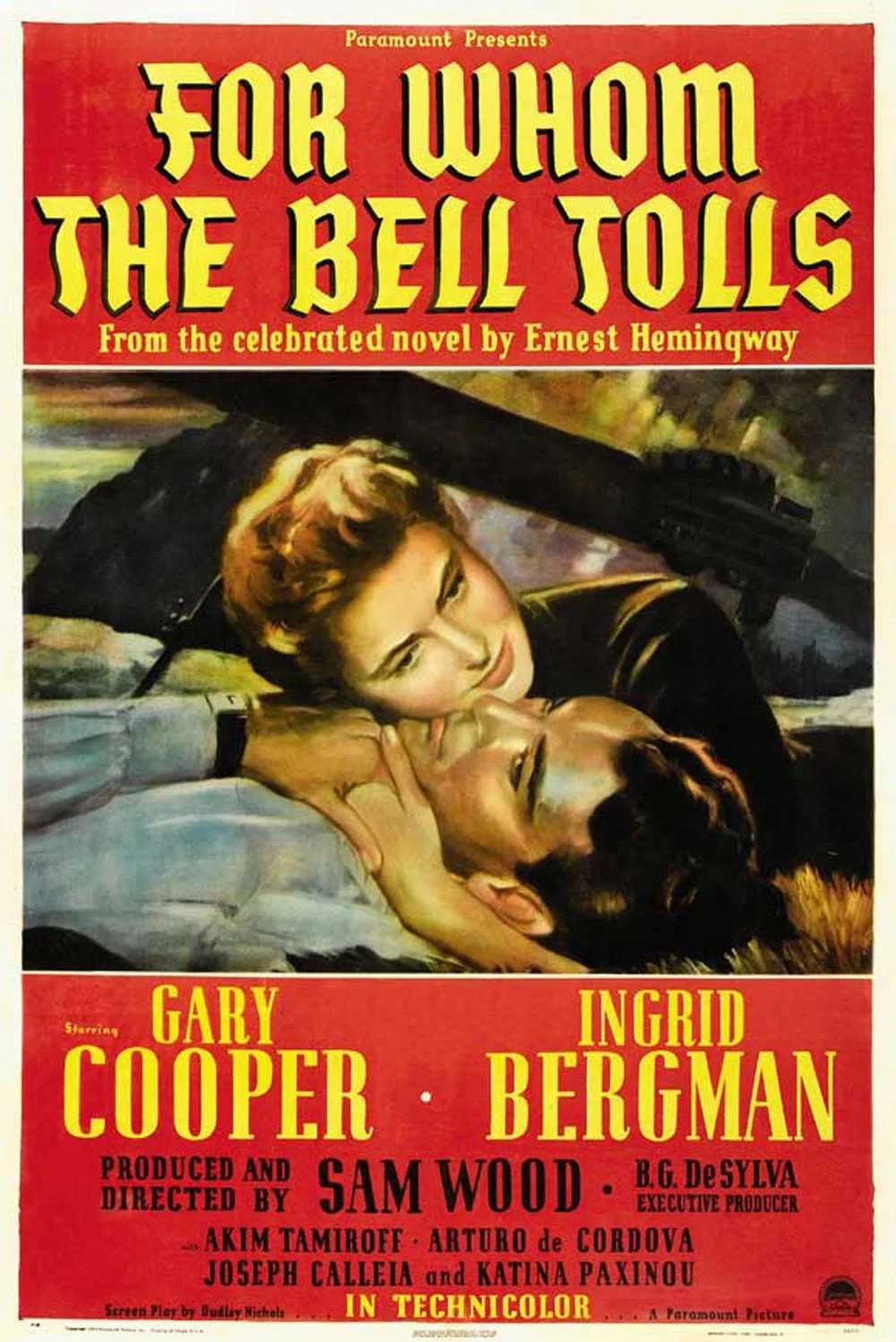
For Whom the Bell Tolls*
For Whom the Bell Tolls
Directed by Sam Wood. 170 mins. (1943)
Gary Cooper – Robert Jordan
Ingrid Bergman – María
An American volunteer fighting with Republican guerrillas during the Spanish Civil War undertakes a dangerous mission to destroy a strategic bridge, forging a brief but profound love amid the violence of war.
Also starring Akim Tamiroff, Vladimir Sokoloff, Fortunio Bonanova, and Katina Paxinou.
Based on Ernest Hemingway’s bestselling 1940 novel. Gary Cooper and Ingrid Bergman were Hemingway’s personal choices for the lead roles.
Nominated for nine Academy Awards, including Best Picture, Best Actor (Gary Cooper), Best Actress (Ingrid Bergman), and Best Supporting Actor (Akim Tamiroff); winner of Best Supporting Actress (Katina Paxinou).
MARIA’S NOTES
Life puts people together in magical ways and when Hemingway was writing For Whom the Bell Tolls he said that he based the Robert Jordan character on that of Gary Cooper the actor and person who he admired a lot. When the mountain retreat soon to become a world class ski resort – Sun Valley – opened, 2 stars walked the dusty streets of nearby Ketchum, Idaho. When Hemingway finished writing For Whom the Bell Tolls, he and his new buddy Gary Cooper would spend days tramping around the “low country” where the hunting for game pheasant and duck was superlative. It was a destination for both men who loved the outdoors and getting away from the pressures of their everyday creative lives.
When it was announced that Hemingway’s book was going to be made into a major motion picture and that Gary Cooper would be the star, for publicity purposes, Paramount Studios commissioned his portrait to be done. The noted Spanish artist Luis Quintanilla was called upon and brought out to Hollywood where he spent time at our home in Brentwood while my father posed for the painting. I happily have just had the opportunity to learn of its whereabouts and acquire it. It’s quite a dramatic portrait which clearly tries to embody the strength, character and heroic nature of Hemingway’s hero Robert Jordan. Mr. Quintanilla’s son Paul has written a fascinating book Waiting at the Shore about his father’s life and art. This painter/adventurer is very much a Hemingway character in his own right and they were in fact strong friends.
The Pride of the Yankees
The Pride of the Yankees
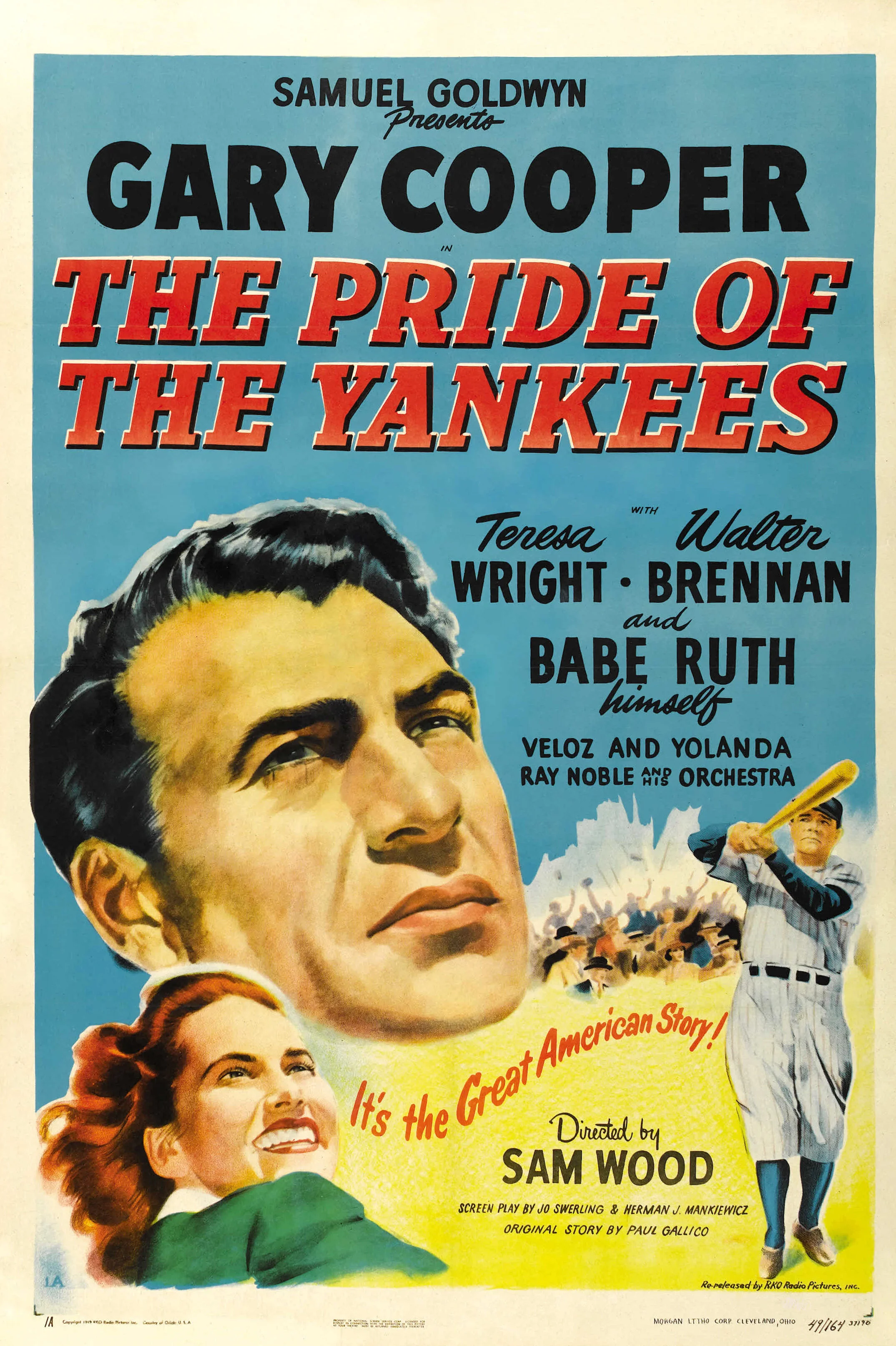
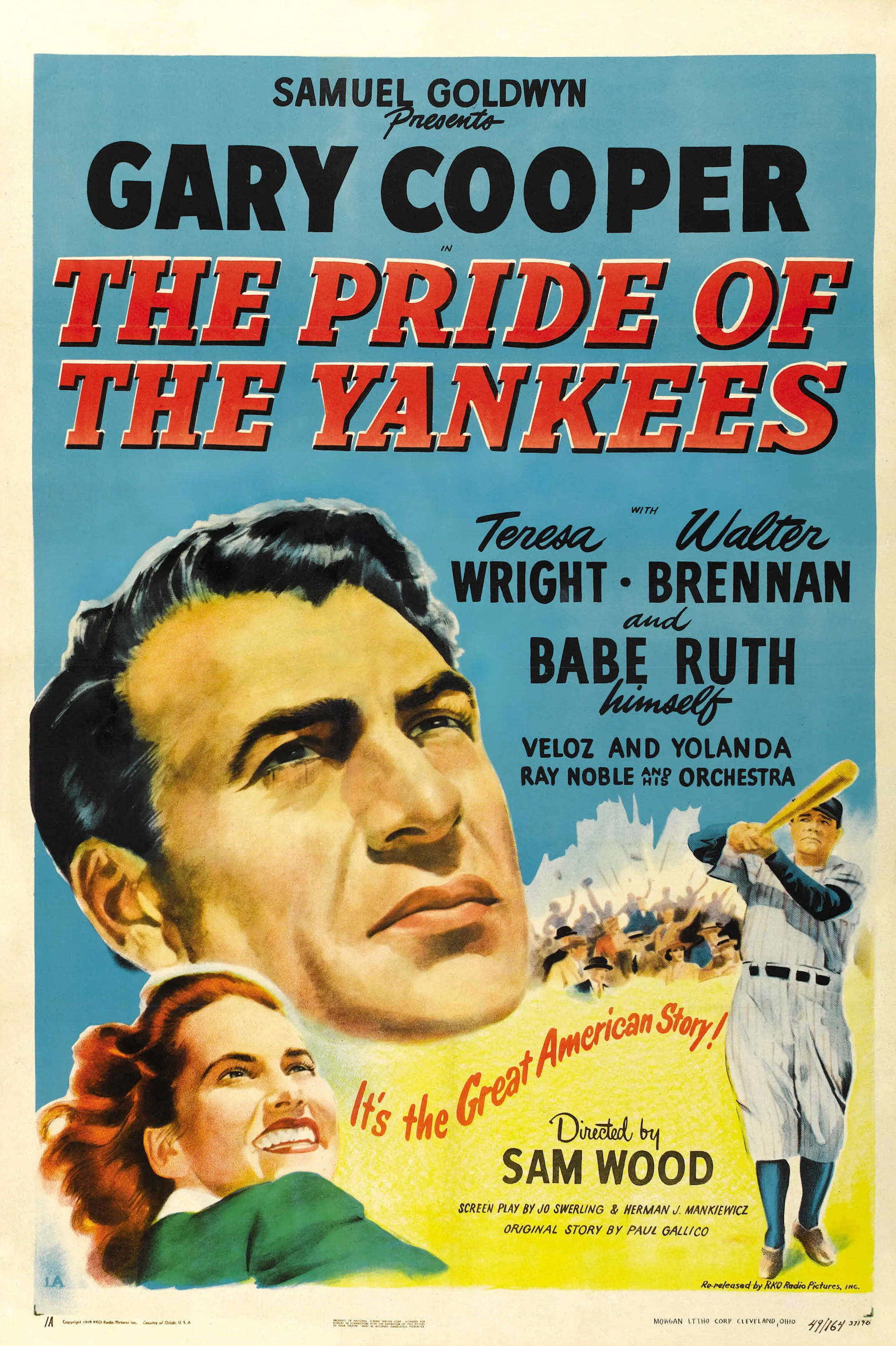
Directed by Sam Wood. 128 mins. (1942)
Gary Cooper – Lou Gehrig
A devoted son and humble ballplayer rises from New York sandlots to become one of baseball’s greatest legends, only to face his greatest trial when a devastating illness brings his record-breaking career to an early end.
Also starring Teresa Wright, Walter Brennan, Dan Duryea, and Babe Ruth as himself.
Based on the life of New York Yankees first baseman Lou Gehrig, whose 2,130 consecutive games earned him the nickname “The Iron Horse.” The film culminates in a recreation of Gehrig’s 1939 farewell at Yankee Stadium, including his immortal declaration that he was “the luckiest man on the face of the earth.”
Nominated for ten Academy Awards, winning Best Original Score.
MARIA’S NOTES
The season starts to change— it stays light a little later each day and, Good news “BASEBALL SPRING TRAINING starts in Florida…which brings my mind always- to one of my father’s favorite films. THE PRIDE OF THE YANKEES in which he plays the role of Lou Gehrig, referred to as The Iron Horse. He batted .300 for 12 straight seasons. His baseball career and life was tragically cut short as he was afflicted by the disease: ALS (Amyatropic Lateral Sclerosis)— known even today as the Lou Gehrig Disease. How awful that even today some 75 years plus later, science and medicine have still not been able to find a cure.
My father was very honored to be chosen to play the role of Lou Gehrig, but he balked at first and he knew one of his major challenges would be to try to be “a lefty” as my father was right handed.Sam Goldwyn, the producer, engaged the ‘training” services of Yankee trainer Lefty O’Doul to coach my father how to throw and bat left handed… I love this photo where O’Doul who believed that chopping wood with a long ax and from the left shoulder— with the wood-chopping stride and rhythm was essentially the same as the batting swing… made an early comment about my father’s efforts… You throw a ball like an old woman tossing a hot biscuit!!”
“Poppa” worked out hard himself at home too, working with a large boxing/punching bag and practicing bowling with his left hand so that using it would become more natural.The idea of playing such a known and beloved person kind of intimidated my father. He said “You can’t “trick up” a part like this with mannerisms or gimmicks.” So many millions of people knew Gehrig, watched him and knew how he handled himself.
When Gehrig was honored at Yankee Stadium he gave one of the most famous ‘farewell” speeches heard either in real life or on the screen.Nothing needed to be added as he walked off the field to cheers, national public admiration and tears.Lou Gehrig continues to be an inspiration to ballplayers and people everywhere who know his story. My husband, concert pianist Byron Janis, who is a huge baseball fan and I brought this Lobby card from the movie as a gift to George Steinbrenner when we sat with him at an “Old Timers Day” game atYankee Stadium. He said ‘Oh, would you like me to take this down to the locker room and get the “boys” to sign it?” Of course I said”. Byron and I love looking at both sides!
Maria Cooper Janis
Sergeant York*
Sergeant York
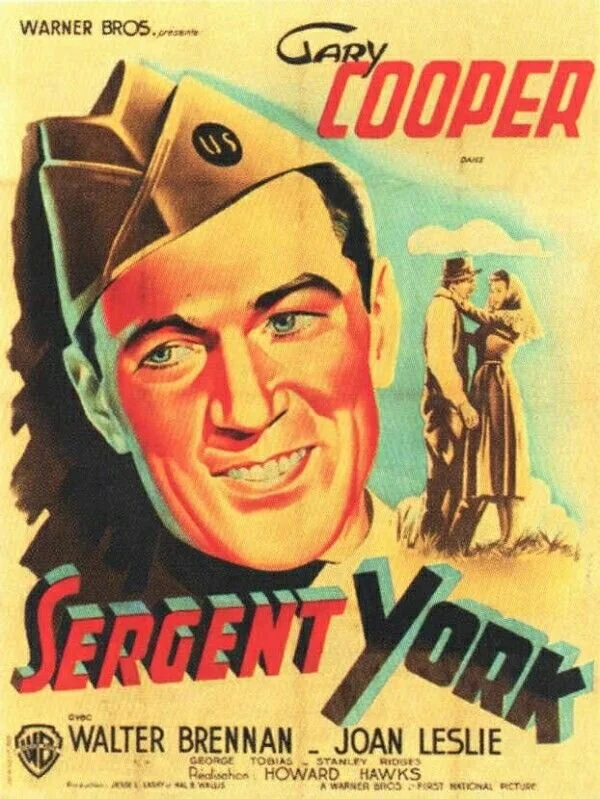
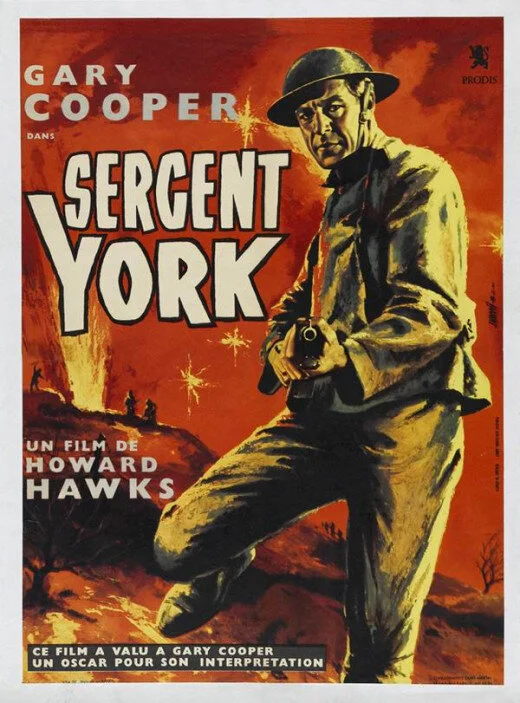
Directed by Howard Hawks. 134 mins. (1941)
Gary Cooper – Alvin C. York
A humble Tennessee farmer and sharpshooter undergoes a profound spiritual awakening that leads him from reluctant conscription to extraordinary heroism on the battlefields of World War I.
Also starring Walter Brennan, Joan Leslie, George Tobias, and Stanley Ridges.
Based on the true story of Alvin C. York, one of the most decorated American soldiers of World War I, whose capture of 132 German troops and destruction of multiple machine-gun nests became legendary. The role earned Gary Cooper his first Academy Award for Best Actor.
Nominated for eleven Academy Awards, winning Best Actor (Gary Cooper) and Best Film Editing.
MARIA’S NOTES
The intersection of lives is a fascinating occurrence as it unfolds in time. The lives of Sergeant Alvin York World War 1 hero and the life of film actor Gary Cooper were melded together when Alvin York told Hollywood that theonly way he would allow his story to be told would be if Gary Cooper portrayed him. It won my father his first Academy Award and it spread the story of York’s heroism to millions of moviegoers around the world.
Some 75 years later at an event paying tribute to the WW1 medal of honor winners in the historical Park Ave. Armory hosted an evening at which both the Cooper family and the York family were together listening to a beautiful song — Song for a Hero composed by Maria Cooper Janis’s concert pianist husband Byron Janis written as a tribute to heros everywhere. It was beautifully sung by singer opera/ broadway artist Frank Basille. Following that was a one act play newly written about Alvin York by… I am so glad to meet and be getting to know the York family, both Col. Gerald York and last year met with one of York’s sons Andrew Jackson York at an event when each of us unveiled US Postal service stamps depicting our fathers. A truly unique and moving moment
A most memorable moment for me happened a few years ago when I found myself sharing a stage with one of the sons of Sergeant Alvin York. We both unveiled 2 large paintings of our Fathers, commissioned by the US Postal Service, as the images for one of the new “forever” stamps that were going to be circulated in post offices around the country.This was held at the amazing World War 1 Museum in Kansas City on the anniversary of Armistice day November 11th.York had become such an American hero—though a reluctant one- as he was a pacifist and did not believe in fighting or killing. Hollywood tried to woo the uninterested and elderly Alvin York, who refused to give the rights to his story to any film makers…unless… they could get Gary Cooper to portray him in a life story movie. My father was so extremely honored and humbled by York's request and, the challenge to take on that role. The two men met and got along beautifully. And so, a beautiful film was made, an inspiring story told, and Gary Cooper won his first Academy Award.
Maria Cooper Janis
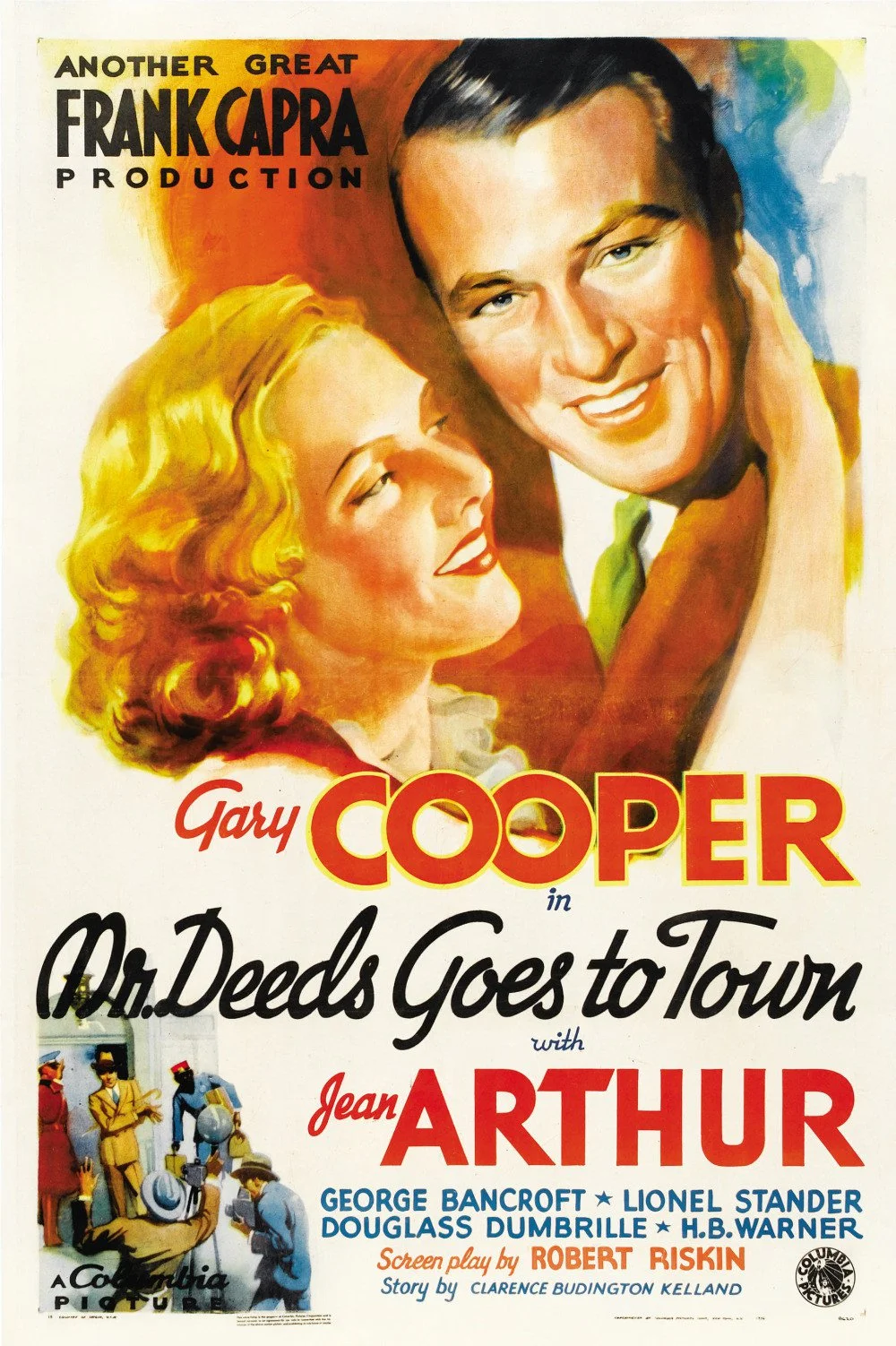
Mr. Deeds Goes to Town
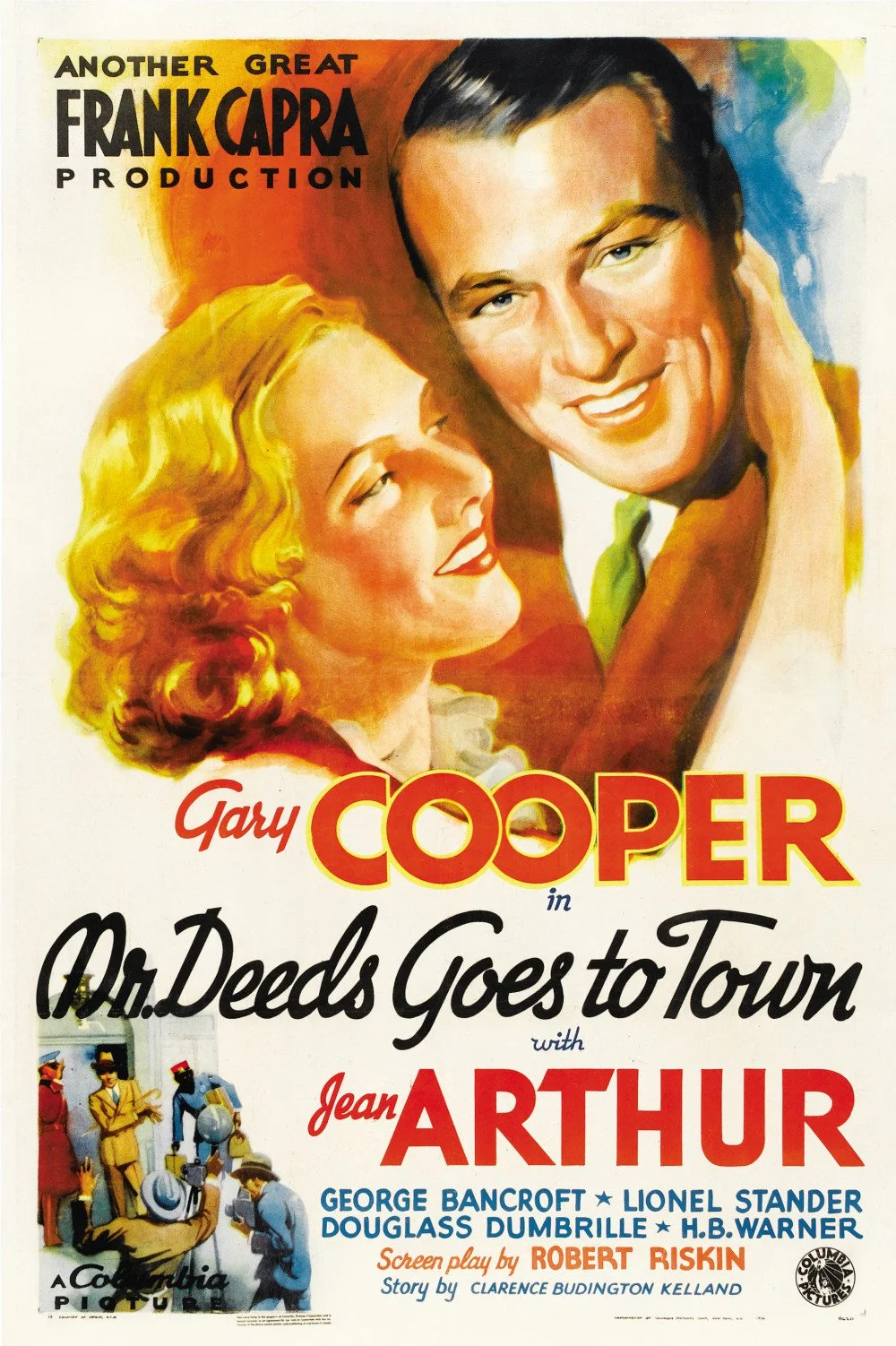
Mr. Deeds Goes to Town
Directed by Frank Capra. 115 mins. (1936)
Gary Cooper – Longfellow Deeds
A kind-hearted small-town poet unexpectedly inherits a vast fortune and moves to New York City, where opportunists, schemers, and a cynical reporter test his innocence—until his integrity quietly transforms those around him.
Also starring Jean Arthur, George Bancroft, Lionel Stander, and Douglass Dumbrille.
Based on Clarence Budington Kelland’s short story Opera Hat, the film became one of Frank Capra’s defining comedies of idealism and earned widespread acclaim for Cooper’s gentle, understated performance.
Nominated for five Academy Awards, winning Best Director (Frank Capra).
MARIA’S NOTES
I have a new insight into the background of one of my favorite of my father's films, Mr. Deeds Goes to Town, chosen by The New York Film Critic’s Circle as the Best Film of the Year (1936) and it garnered 5 nominations from the Motion Picture Academy - Frank Capra won for Best Director.
It is one of the key films in the career of Gary Cooper and was directed by the great Frank Capra with Robert Riskin writing the screenplay. His daughter Victoria Riskin has written a most interesting book about her father and mother, Fay Wray, one of the beautiful actresses of that era which gives an extremely accurate and fascinating look into the Hollywood of that time.
When asked about her father and which films most closely reflected his personal philosophy, she named Mr. Deeds as one of them. His development of the character Mr. Longfellow Deeds embodies the fact of the essential goodness of ordinary people and the ability of one man to stand up to the corruption and power plays of the rich and influential.
The film comments on that and the vulnerability of human nature. This all came together marvelously as directed by Capra and sensitively portrayed by my father with some good bits of humor thrown in. The chemistry between Jean Arthur and Gary Cooper was hidden in the beginning but poignant when finally revealed.
In January 2025, I had the wonderful experience of seeing Mr. Deeds on a big screen. It was shown as part of a Holiday series at the Film Forum in New York. One cannot compare the dramatic impact of watching a movie – any movie – as it was originally meant to be viewed. All aspects of the art form - from the acting, photography, sound effects, the impact of dialogue or the impact of silence - can only fully be appreciated in this way and not reduced to a screen measuring inches instead of feet.
Maria Cooper Janis
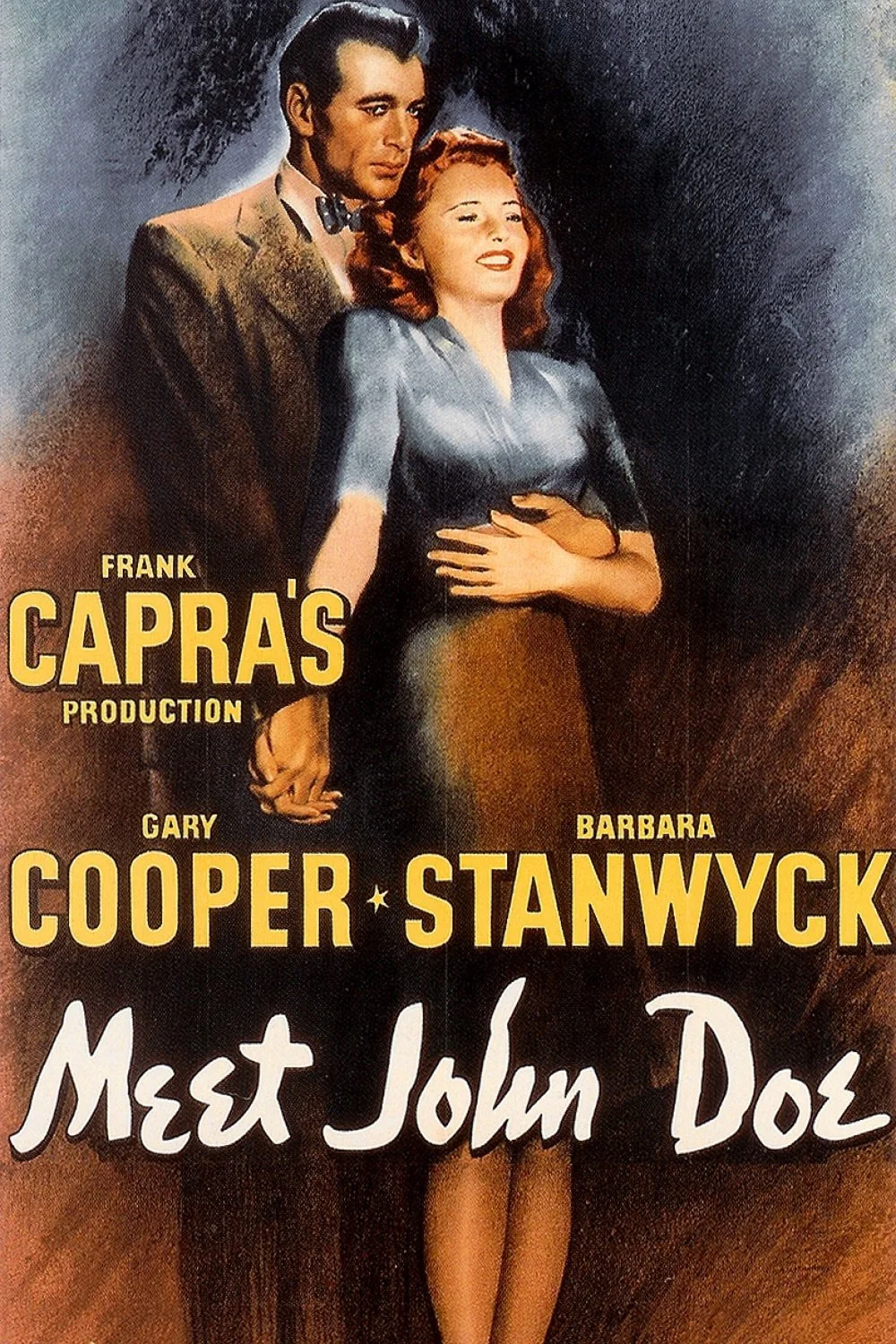
Meet John Doe*
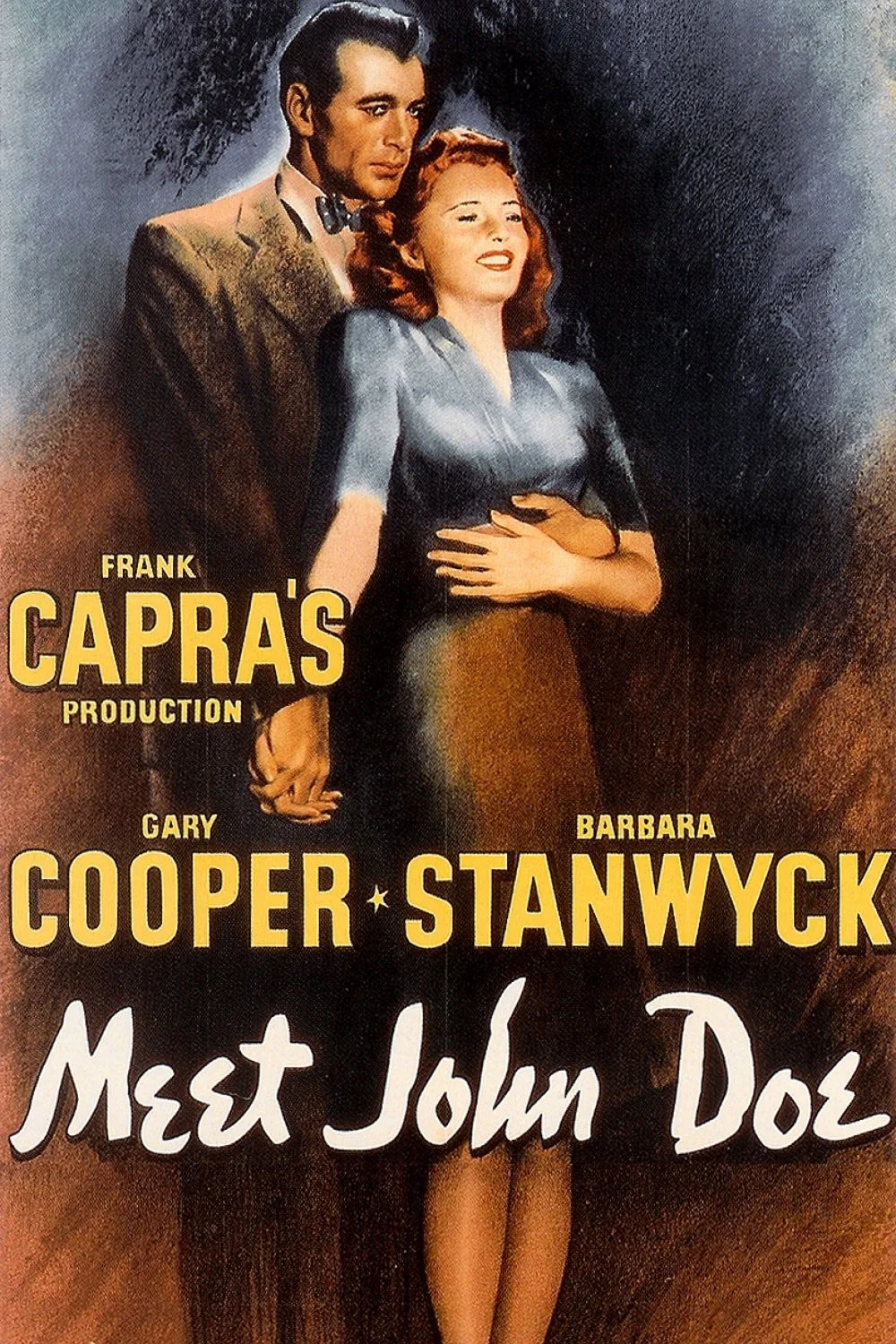
Meet John Doe
Directed by Frank Capra. 122 mins. (1941)
Gary Cooper – John Doe / John Willoughby
An out-of-work drifter is hired to impersonate a fictional everyman created by a cynical newspaper stunt, but as the invented “John Doe” philosophy inspires a nationwide grassroots movement, he becomes torn between manipulation, fame, and the search for genuine purpose.
Also starring Barbara Stanwyck, Edward Arnold, Walter Brennan, James Gleason, and Gene Lockhart.
Based on a story by Richard Connell and Robert Presnell Sr., the film reflects Frank Capra’s enduring themes of populism and media influence; early preview versions featured a tragic ending in which John Doe dies, but audience response led to the now-famous redemptive conclusion.
Nominated for the Academy Award for Best Original Story.
MARIA’S NOTES
Every time I watch my father in Frank Capra’s film Meet John Doe, written by Robert Riskin, I am caught up again in the emotion and tensions of the film’s story which deals directly with how my father portrayed the strong, sensitive, naïve and very human aspects of human nature.
His portrayal lets the audience relate to the emotional conflicts and feelings that John Doe himself experiences. In a scary way, the film portrays all of us John Does and the conflicts we face as we fight to maintain our own sense of honesty and integrity in the pressure cooker of the “dark side” trying to overcome the better angels of our nature. Hope and redemption win out in the end but the conflicts that live inside John Doe are elements that we all are faced with in our lives.
The strength of human spirit, a higher power, or whatever you choose to call it when threatened by darkness, is overcome by the light.
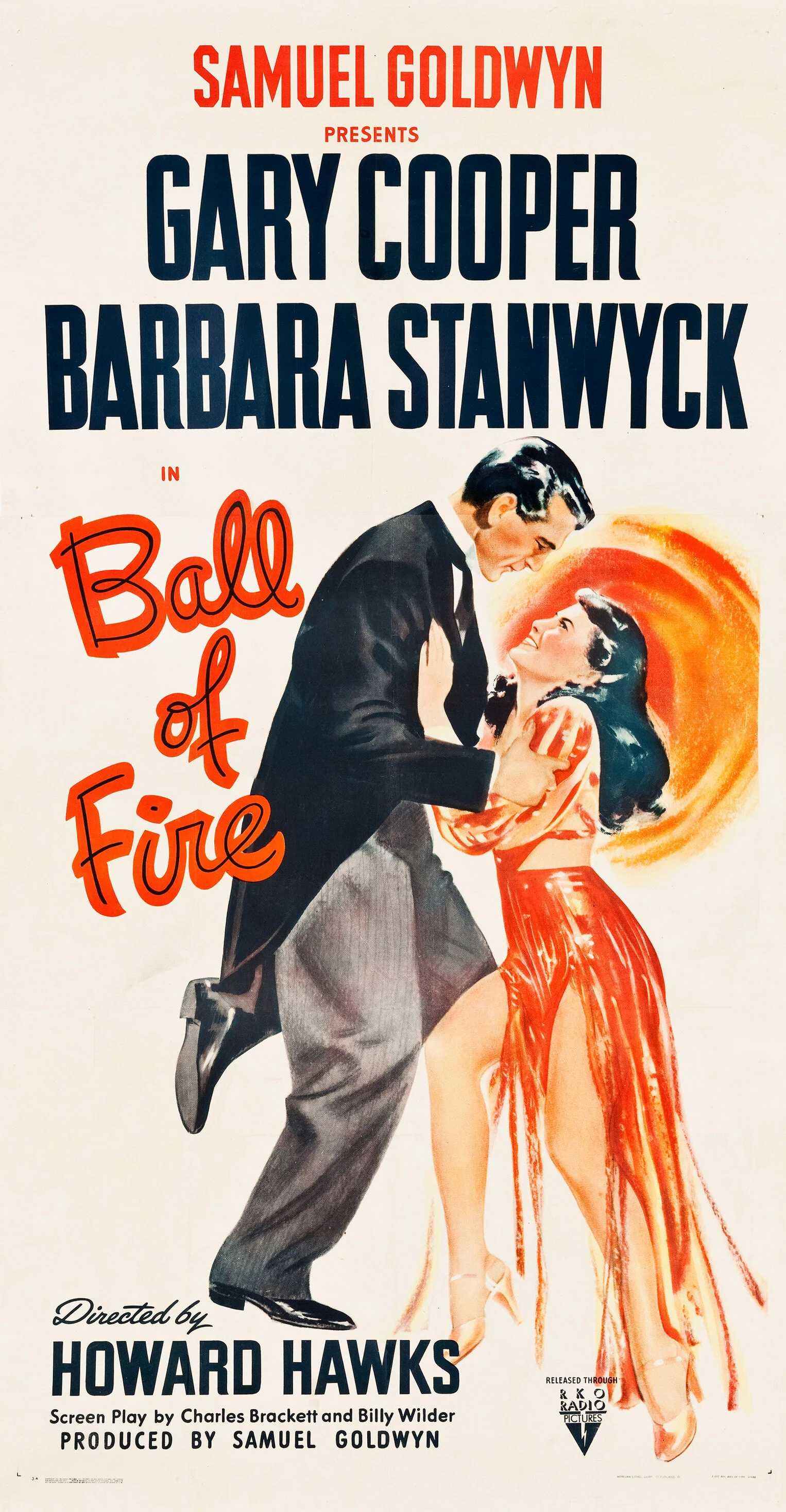
Ball of Fire
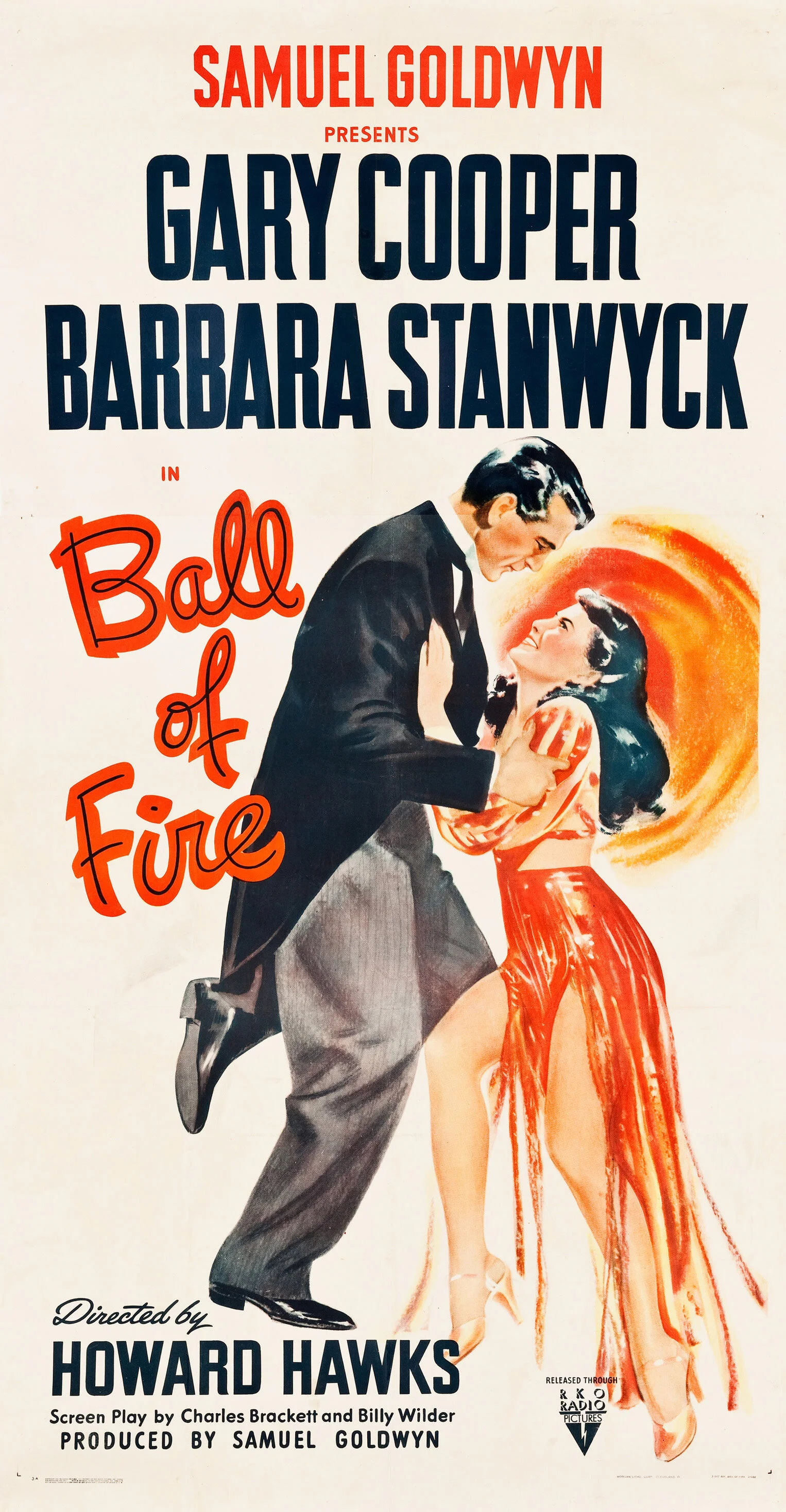
Ball of Fire
Directed by Howard Hawks. 111 mins. (1941)
Gary Cooper – Professor Bertram Potts
A shy linguistics professor, secluded with a team of fellow scholars compiling an encyclopedia, ventures into the modern world to research contemporary slang and unexpectedly falls under the spell of a streetwise nightclub singer hiding from the law.
Also starring Barbara Stanwyck, Oskar Homolka, Henry Travers, Richard Haydn, and Dana Andrews.
Written by Billy Wilder and Charles Brackett and inspired by Snow White and the Seven Dwarfs, the film pairs Cooper’s naïve academic with Stanwyck’s fast-talking performer in one of Hollywood’s most celebrated screwball comedies. The writers famously gathered authentic slang by observing teenagers, burlesque performers, and racetrack crowds around Los Angeles. The film received four Academy Award nominations.
MARIA’S NOTES
This film is well described by delighted critics as a screwball comedy. It was originally titled The Professor and the Burlesque Queen. It gave my father the opportunity to stretch his “comedic chops” in his own subtle ways. He was happy to be working again, after the film Meet John Doe, with his old family friend and co-star Barbara Stanwyck who earned an Oscar nomination for her role as an exotic dancer named Sugar Puss O’Shea. Gary Cooper plays an English professor upgrading encyclopedias with his friends when some gangsters come into the plot and wonderful laughs ensue throughout the movie. I had never seen this on a big screen until the Gary Cooper Film Festival hosted by Southampton Playhouse, and the experience was wonderful.
Maria Cooper Janis
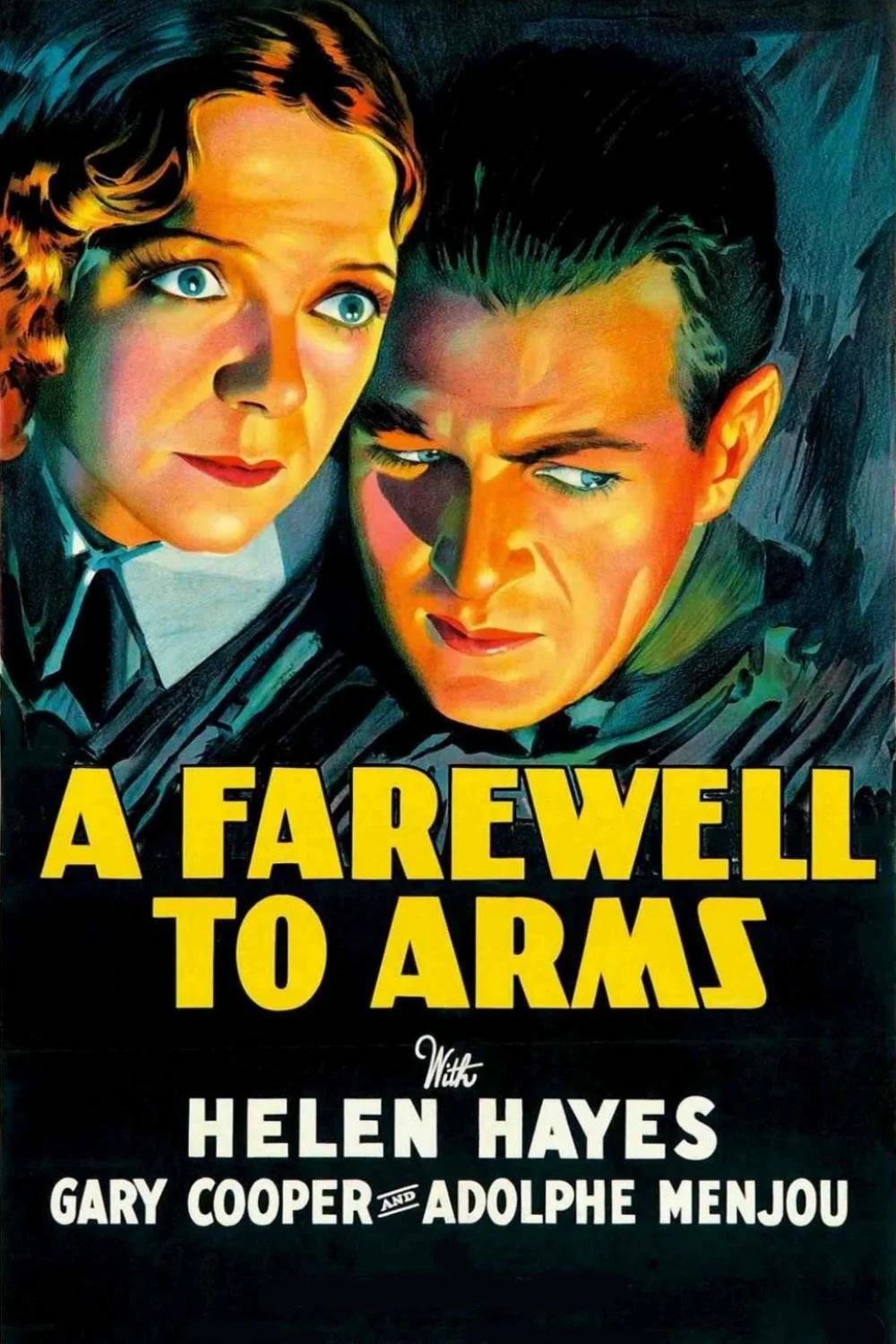
A Farewell to Arms
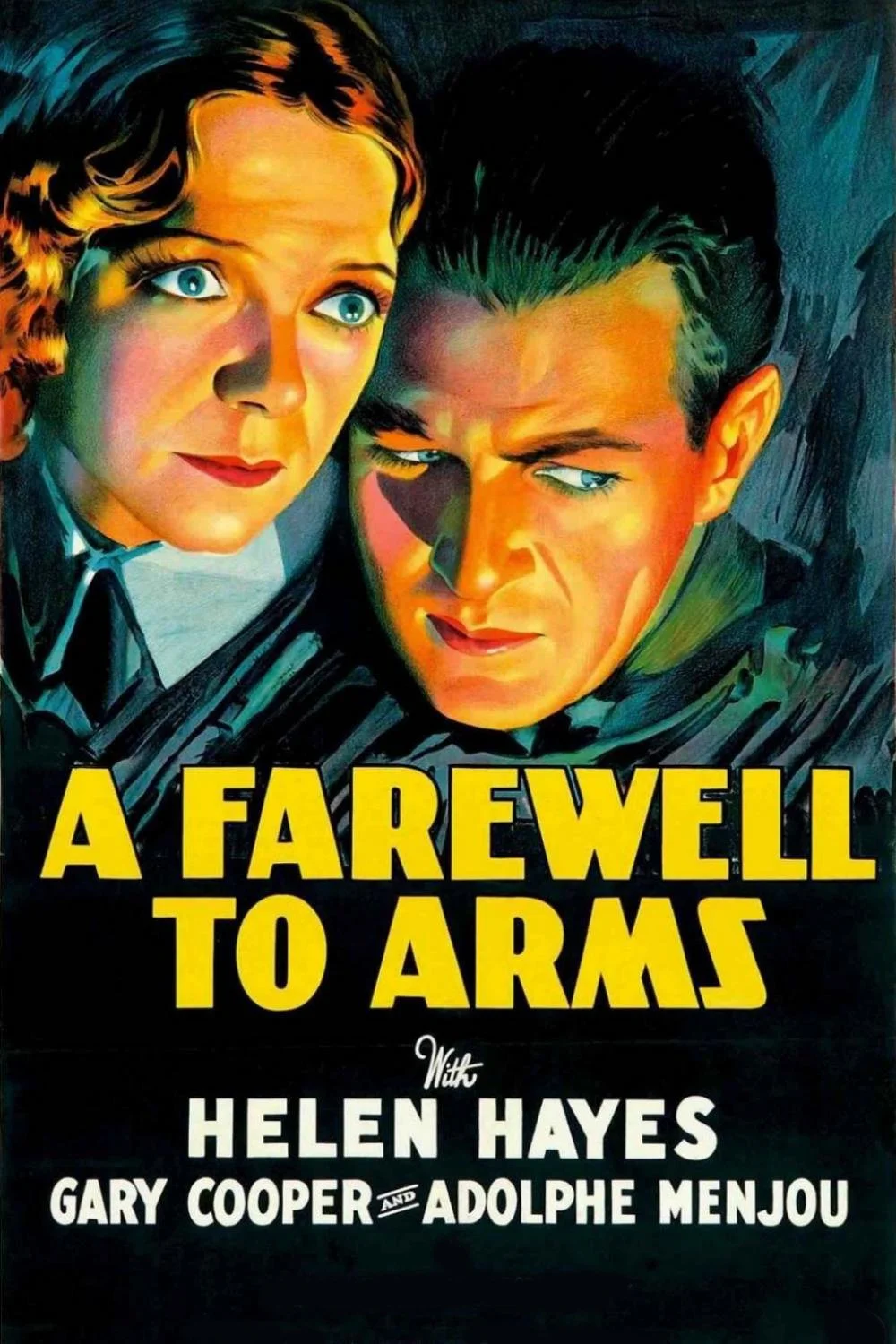
A Farewell to Arms
Directed by Frank Borzage. 80 mins. (1932)
Gary Cooper – Lieutenant Frederic Henry
An American ambulance officer serving in Italy during World War I falls deeply in love with a devoted British nurse, and together they struggle to find meaning and refuge amid the devastation and disillusionment of war.
Also starring Helen Hayes, Adolphe Menjou, Mary Philips, Jack La Rue, and Mary Forbes.
Based on Ernest Hemingway’s 1929 novel, the film was among the earliest serious Hollywood treatments of World War I romance and helped solidify Cooper’s image as a conflicted yet idealistic hero. It received four Academy Award nominations, winning for Best Cinematography and Best Sound, and was later remade in 1957 starring Rock Hudson and Jennifer Jones.
MARIA’S NOTES
It does seem like Gary Cooper and Ernest Hemingway were destined to meet and become friends, although A Farewell to Arms was made before those two men had ever encountered each other.
My father portrayed the protagonist Lieutenant Frederic Henry and his co-star Helen Hayes, the First Lady of the American theater, starred as love interest Catherine Barkley. The story takes place in war torn Italy in World War 1 and the two of them fall in love. In real life, Helen, by her own admission, became totally smitten by my father. She said “ …if only he had wiggled his finger at me to come meet him, I would have left my husband (the writer Charles McArthur) and child and run off with him.” She muttered this in between takes of one of their love scenes in the picture, looking adoringly into my father’s eyes. She recalled, “Gary looked back at me, took me firmly by my shoulders and said ‘NO, HELEN , NO.’” Nevertheless, they remained friends even though much of her acting life was still devoted to theater and she lived in New York City.
The studio shot 2 different endings for the film. The first was the Hemingway ending, faithful to the novel, in which Catherine dies in Frederic’s arms, and the second was the “Hollywood Ending” where she lives. The studio and distributors opted for the Hollywood ending at first, but later distributed the film internationally with the Hemingway ending where Miss Hayes dies in Cooper’s arms. In some cases at select American theaters, moviegoers could choose which ending they wanted to see.
When I met Miss Hayes for the first time, my husband and I were invited to visit her at her home in Nyack, New York. She greeted us at the front door and as she opened it, she saw me silhouetted by the sunlight outside. She exclaimed, “Oh, you look just like Gary standing there, tall and quiet.” It was a very emotional moment for me. I really did not know what to say and could only focus on the deep feelings running through me. After so much time, a connection was still there. She was as beautiful at the height of her career as she was when I met her––an angel.
Maria Cooper Janis
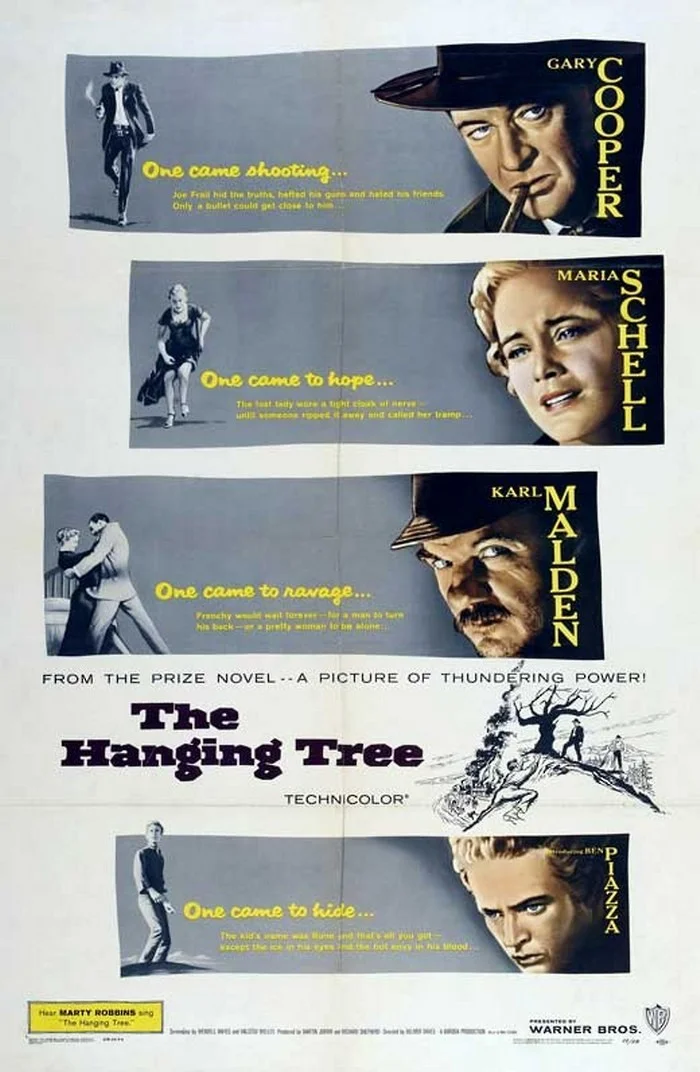
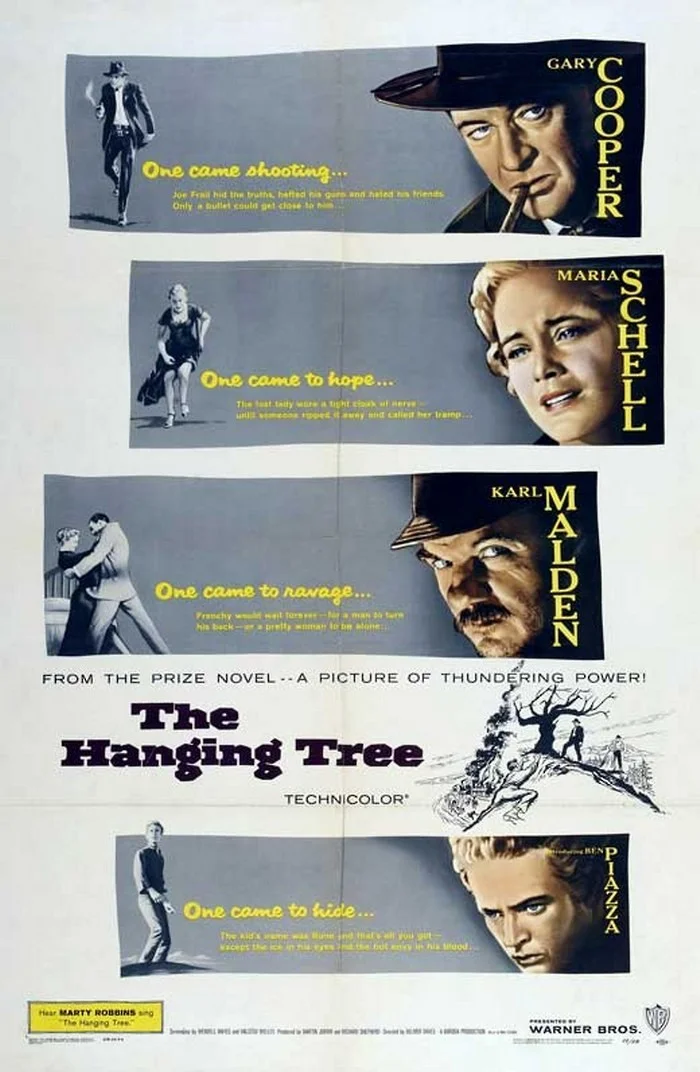
The Hanging Tree*
The Hanging Tree
Directed by Delmer Daves. 107 mins. (1959)
Gary Cooper – Dr. Joseph Frail
A mysterious frontier doctor saves a wounded outlaw from a lynch mob in a Montana gold camp, then exerts a troubling hold over the young man’s fate while confronting secrets from his own past.
Also starring Maria Schell, Karl Malden, George C. Scott, Karl Swenson, Virginia Gregg, and Ben Piazza.
Based on Dorothy M. Johnson’s 1957 novel, the film blends Western drama with psychological tension; its haunting title song, performed by Marty Robbins, earned an Academy Award nomination.
MARIA’S NOTES
The Hanging Tree is a film that was particularly close to my father’s heart. Certain things resonated for him relating to his Montana childhood, the lure of the gold rush days in 1873 and many of the flaws in our human nature so graphically depicted in the plot of the film. As the main character, a doctor named Joe Frail, it also provided my father with a chance to play a much darker role than usually attributed to Gary Cooper. The atypical Cooper role in the persona of Dr. Frail is not one his public was used to seeing him in and he relished the chance to play a role that stretched him. The superb cast of Maria Schell (her first American film), the wonderful Karl Malden, seasoned director Delmer Daves, came together to make this the unique film that it is. Del Daves sometimes seemed to vanish from the camp near Yakima, Washington. In the course of filming, it was discovered that he was an avid amateur geologist and rock/mineral collector and he would venture off on his own personal expeditions to find a special kind of ancient rock formation – or perhaps it was the remnants of some gold nuggets flushed out of the mountains after a heavy rain. At one point, Daves took ill and Karl Malden came to the rescue encouraged by my father to take the reins as needed. I still have a gold nugget from the site that my father made into a pendant.
As I watched my father Gary Cooper's film The Hanging Tree now, 60 plus years after it was made, I am more aware than ever of how natural Gary Cooper’s acting style was - though I don’t think he would have referred to himself as having an “acting style.” He worked at immersing himself in the character and then let his intuitive feelings and emotions about who that character was, what drove him to be and do the things he did, come naturally then he said, “I don’t have to act.” As an unusual Gary Cooper type in The Hanging Tree, he portrays a much “darker” hero and his face reflects layers of inner conflicts not usually identified with a typical Western hero, particularly Gary Cooper. His character, a doctor named Joe Frail, is trying to escape his past memories - most raw, his personal wounding by his betrayal by his wife with his own brother. Maria Schell, the beautiful talented actress from Germany, is given her first American film and she is given a more complex female role than those usually handed to women in a Western film - she is neither a prostitute nor a school marm. There is a haunting musical score by Max Steiner and performed by Marty Robbins that threads through the film as it captures the emotional drama of anger, sadness and ultimately love which is portrayed at the end of the film.
Maria Cooper Janis
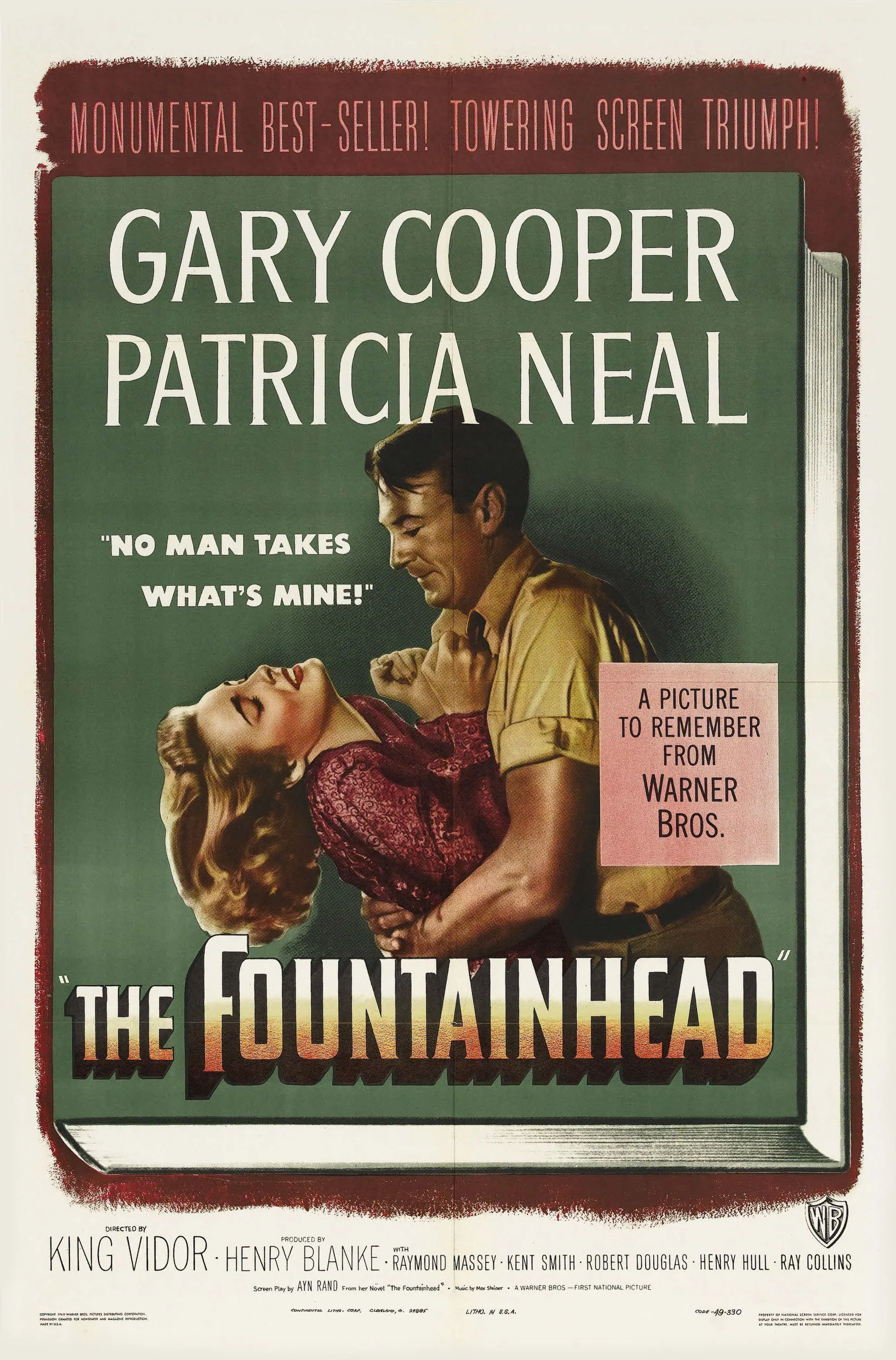
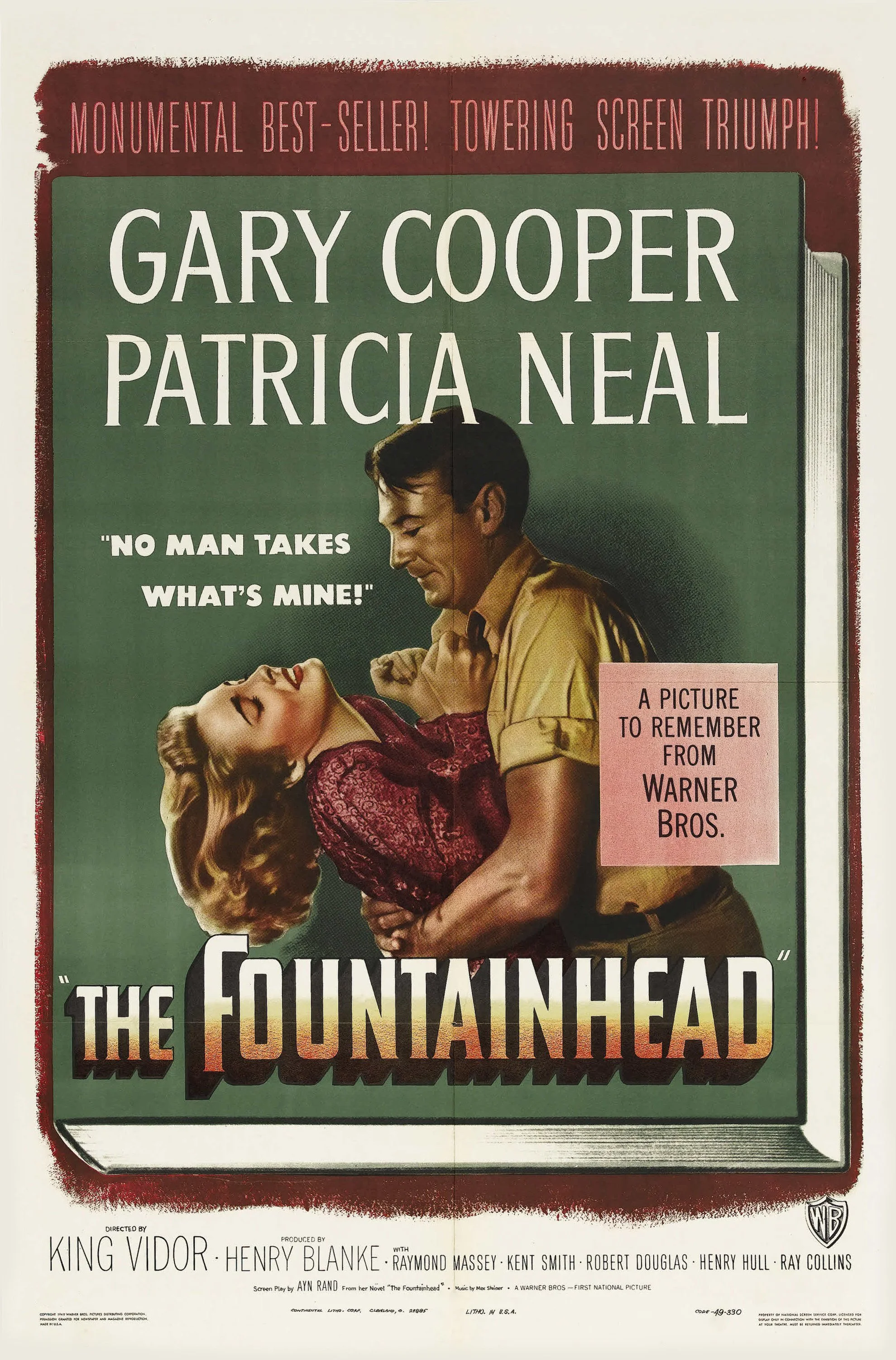
The Fountainhead*
The Fountainhead
Directed by King Vidor. 114 mins. (1949)
Gary Cooper – Howard Roark
An uncompromising modernist architect defies convention and public opinion to pursue his visionary designs, refusing to sacrifice his artistic integrity despite mounting personal and professional costs.
Also starring Patricia Neal, Raymond Massey, Kent Smith, Robert Douglas, and Henry Hull.
Based on Ayn Rand’s 1943 bestselling novel and adapted by the author herself, the film cast Gary Cooper at Rand’s insistence over studio preference for Humphrey Bogart. Roark’s climactic courtroom speech was among the longest delivered on screen at the time.
MARIA’S NOTES
Ayn Rand, adored by many, disliked by many. Her philosophy and persona I find abhorrent. One of her famous novels, The Fountainhead, became the movie vehicle for my father to star in - playing a loosely reminiscent characterization of the famous architect Frank Lloyd Wright. In her novel, the character Howard Roark, adheres to her “philosophy of man as a heroic being with his own happiness as the moral purpose of his life.” This is just so opposite to everything Gary Cooper stood for - it was a most curious artistic stretch for my father to portray that kind of person - someone whose life glorified selfish individualism. Just about the opposite as you could get from Mr. Deeds or Meet John Doe
Roark is a ruthless character and Ayn Rand insisted that Gary Cooper was the only person she wanted to play the role. Warner Brothers, who produced the film, originally thought of Humphrey Bogart to play my father’s part as they felt he could portray a man more fanatical and extreme. But he did not cut the mustard with Ayn Rand as she wanted the romantic figure that Gary Cooper represented - and she called the shots even to the point of writing the script herself. She was able to intimidate Warner Brothers and it was quite amazing that the film in those days got released because of quite sexually exploitive and violent scenes which the censors tried to curtail.
It was only the second film for the budding young actress Patricia Neal who fit the role of Dominique Francon, a sexually aggressive woman who is a manipulator, seducer and a destroyer. The relationship on screen between Howard and Dominique was volcanic and in many cases very over the top. The film, at the time, received very poor reviews but somehow through the years it has become a kind of cult classic.
Maria Cooper Janis
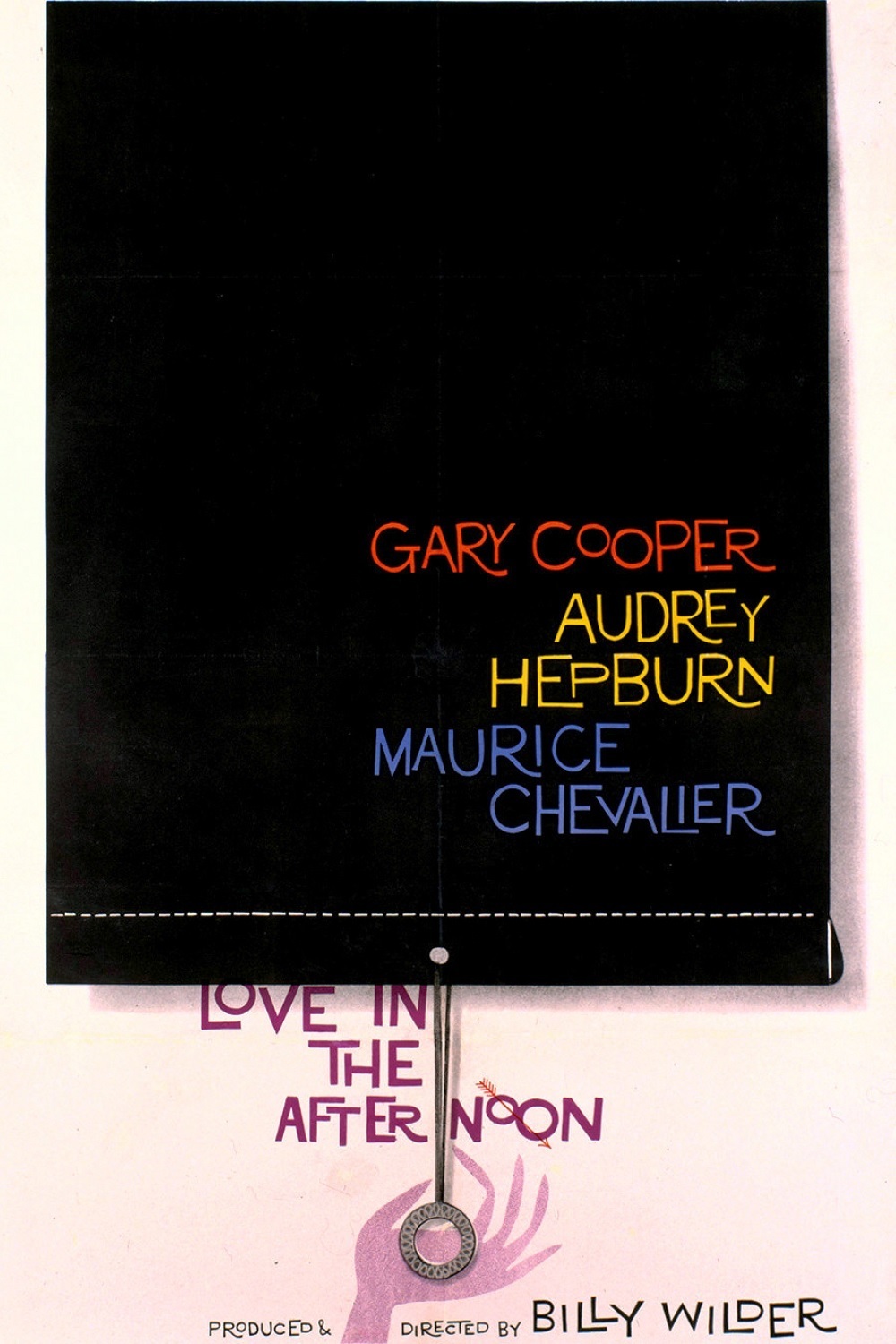
Love in the Afternoon*
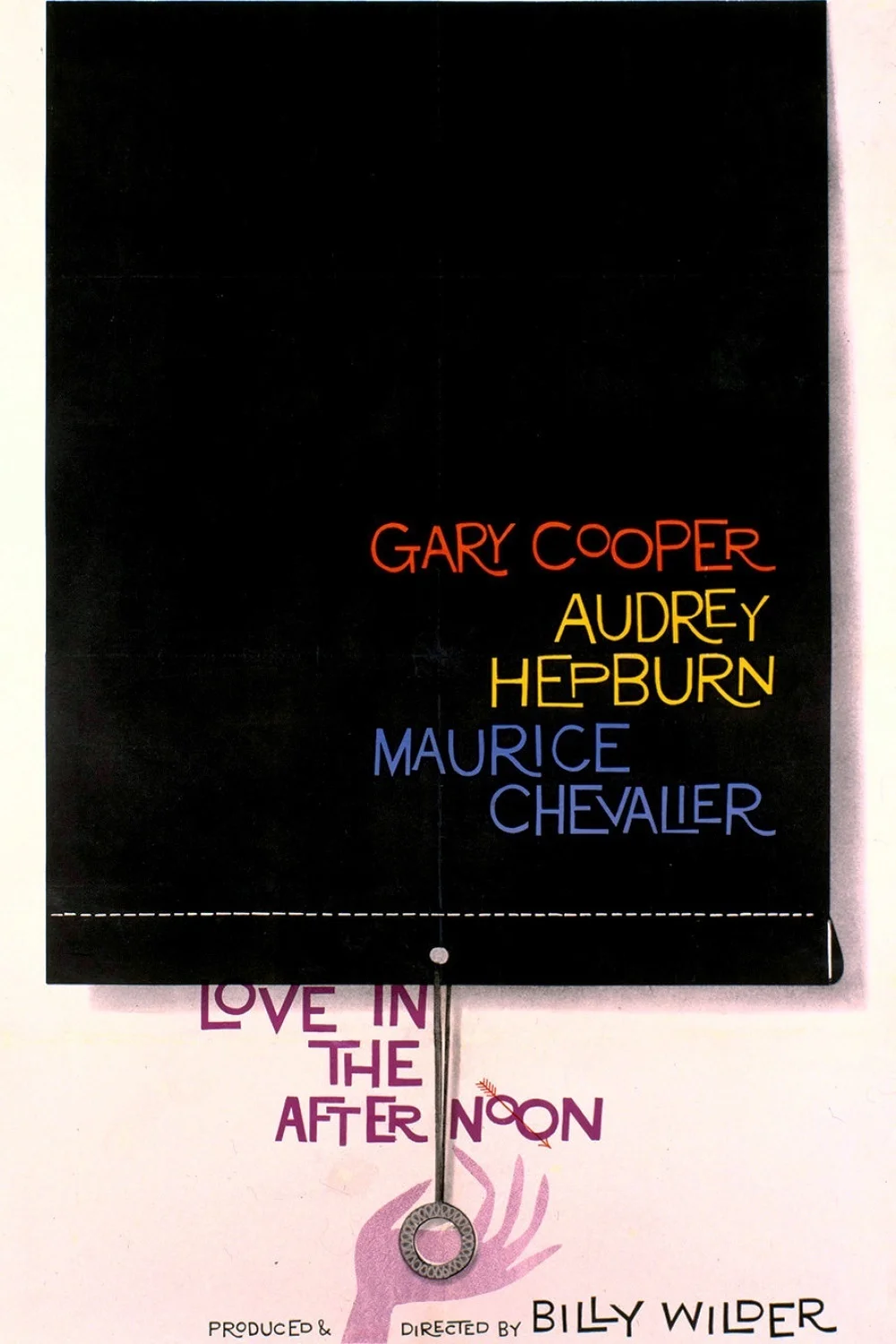
Love In the Afternoon
Directed by Billy Wilder. 130 mins. (1957)
Gary Cooper – Frank Flannagan
A charming American playboy in Paris becomes the target of a jealous husband’s murder plot, only to find himself unexpectedly drawn to the naïve young daughter of the private detective hired to protect him.
Also starring Audrey Hepburn, Maurice Chevalier, John McGiver, Van Doude, and Lise Bourdin.
Billy Wilder’s romantic comedy pairs Gary Cooper with Audrey Hepburn in a May–December romance that tested censorship boundaries; a dubbed line was added to soften implications of their intimacy. The film received multiple international awards and honors.
MARIA’S NOTES
The movie Love in the Afternoon was taken from a popular french story titled “Arianne."
It is a film in which Gary Cooper plays not to his typical film image at all. Every actor wants to ‘stretch his abilities, and take on different personas. He had gotten a piece of advice in the early days from Sam Goldwyn who said in effect-" to be careful Coop and never let your public down. They don’t want to see you as other than the “hero,” in whatever form…”
His character Frank Flannagan in Love in the Afternoon is a tycoon/playboy of a “certain age” who has been definitely around the track many times and is romancing a very young, beautiful, charming cello student, Audrey Hepburn, who lives with her detective father, Maurice Chevalier. It reunites professionally Cooper and the great director Billy Wilder, who were close personal friends (their first film together was with Claudette Colbert in Bluebeards’s Eighth Wife in 1938 ).
Wilders first choice for this role was Cary Grant or Yul Brynner, however schedules didn’t permit, but given Coopers age Wilder felt it could work very well with him portraying such a sophisticated scoundrel. My father was tired playing ‘virtuous” roles, wanted to do the film, work with Billy again, and then--location in Paris was NO hardship!
One of the lovelier scenes takes place when he is having a picnic in the Bois ( the park) in Paris. I was visiting the shoot that day and when the crew took a lunch break my father said to me,” Do you want to go for a row on the lake.? It was beautiful as he got his daily workout by rowing very energetically around the little islands of trees and flowers, but funny to see all the crowds lining the banks of the large lake..all pointing and wondering who was the young lady in the rowboat with Gary Cooper????
Does the comedy give Cooper the chance to redeem himself in the end??. I invite you to watch a kind of magical romance and find out for yourself.
Maria Cooper Janis
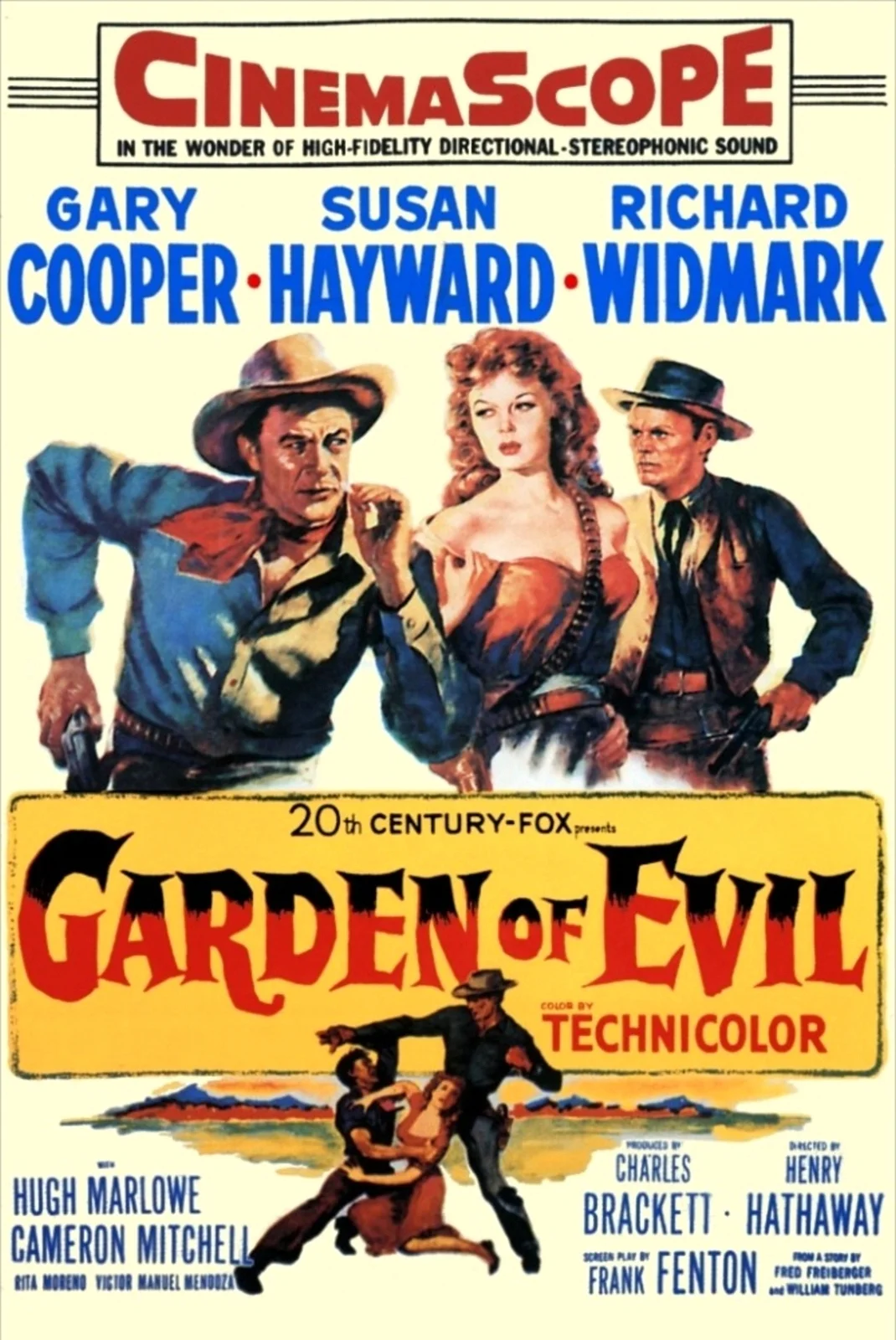
Garden of Evil
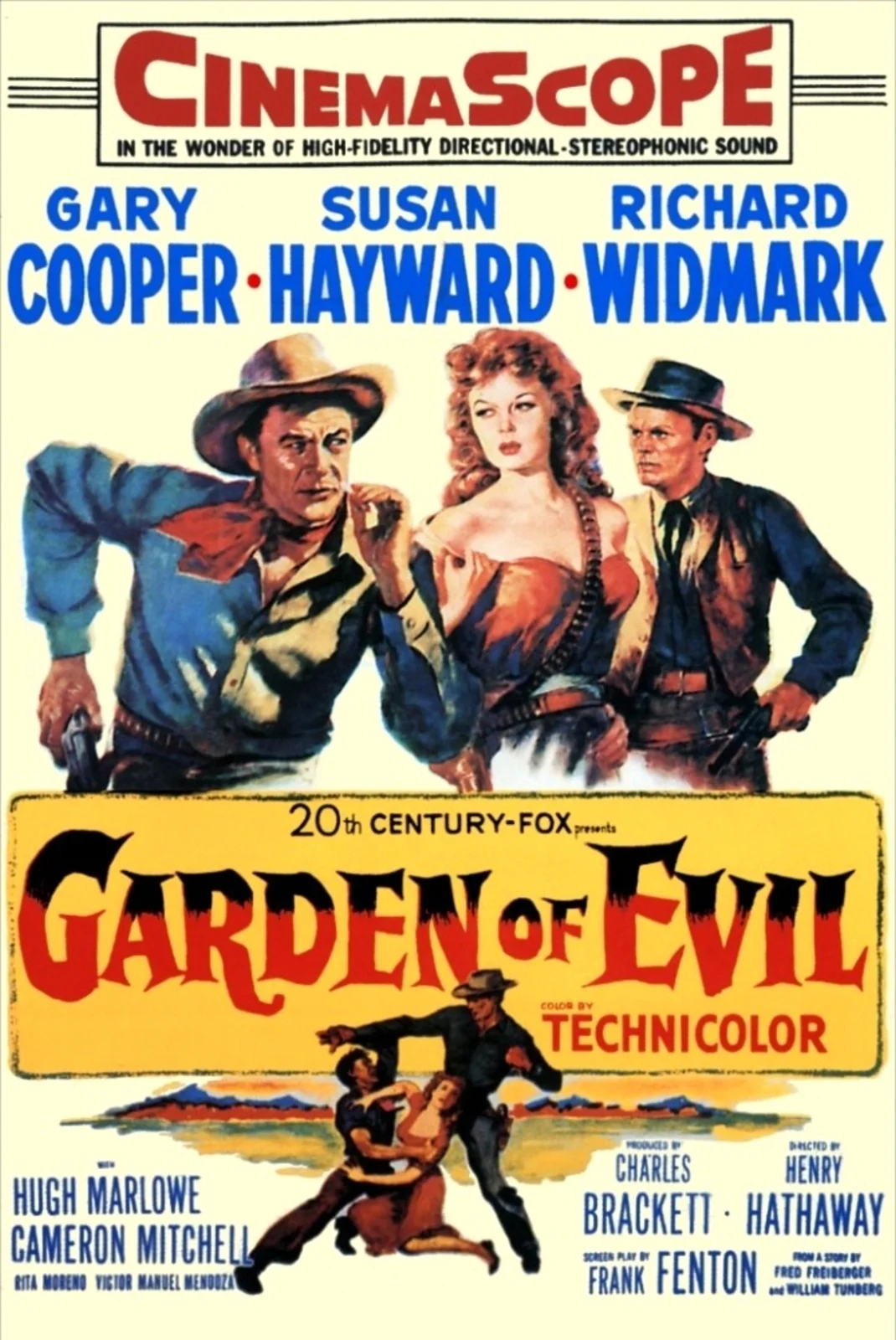
Garden of Evil
Directed by Henry Hathaway. 100 mins. (1954)
Gary Cooper – Hooker
Stranded in a remote Mexican village on their way to the California gold fields, three American adventurers accept a perilous mission to guide a determined woman through hostile mountain territory to rescue her husband, trapped in a collapsed gold mine—each man weighing the promise of fortune against his own motives and survival.
Also starring Susan Hayward, Richard Widmark, Hugh Marlowe, Cameron Mitchell, and Rita Moreno.
Bernard Herrmann’s atmospheric score anticipates musical themes he later developed for Alfred Hitchcock’s Vertigo. Shot on location in Mexico, the film blends psychological tension with rugged frontier adventure.
MARIA’S NOTES
It was rare that my mother and I would join my father on location but it was Christmastime and we wanted to be together as a family so there we were in Cuernavaca, Mexico while the shooting was taking place in the nearby countryside and at the foot of the mountains. It was very rugged territory around Uruapan with a mixture of jungles, black volcanic rock and sinister looking black sand. The Director was a longtime family friend, Henry Hathaway, who had in fact directed my father in 7 previous films.
For the most part, we were all based in Cuernavaca and it was wonderful to be around the Hathaways whom I called Uncle Henry and Aunt Skip. Henry was a passionate and exacting Director and the frustrations of this location drove him crazy. I’ll never forget one complex scene in particular. The “good guys” are trapped in a ravine with cliffs rising high above them, over 1,000 feet, creating a narrow escape route for my father and his team. Of course, the Indians did not like their territory being invaded by the “white man” and were not friendly. The great dramatic shot was supposed to have my father and friends trapped in this ravine with the canyon walls looming over them. Hundreds of Indians on horseback were supposed to appear at the rime of the mesa. A great shot if they were lined up like the Rockettes. They were supposed to appear all at the once silhouetted against the blue cloudless sky.
This was not the day of cellphones. The walkie-talkies we had were not working and Henry was obliged to yell all directions through a gigantic bullhorn. But I guess the wind was blowing the wrong direction because Henry’s instructions seemed to be of no avail. The Indians who were supposed to appear all at once at the rim of the plateau didn’t seem to hear him and with retake after retake, there were only clumps of Indians, not looking very threatening - no dramatic effect at all. Henry yelled and cursed, turned crimson in rage – I was afraid a heart attack was imminent.
My father’s costars were Susan Hayward and Richard Widmark and were fun to hang out with after a day’s shooting and I had the pleasure of being part of the group and dancing with Mr. Widmark. One of the other costars made a bit of a scene off camera with Miss Hayward. One morning he appeared on the set with 4 deep, red, long, fingernail gashes across his cheek. The part called for him to look rather beaten up so the makeup woman did not have to camouflage too much.
My father loved Mexico – its people, their food and the wildness of its natural environments – and relished every time a film could be shot on location in that country.
Maria Cooper Janis
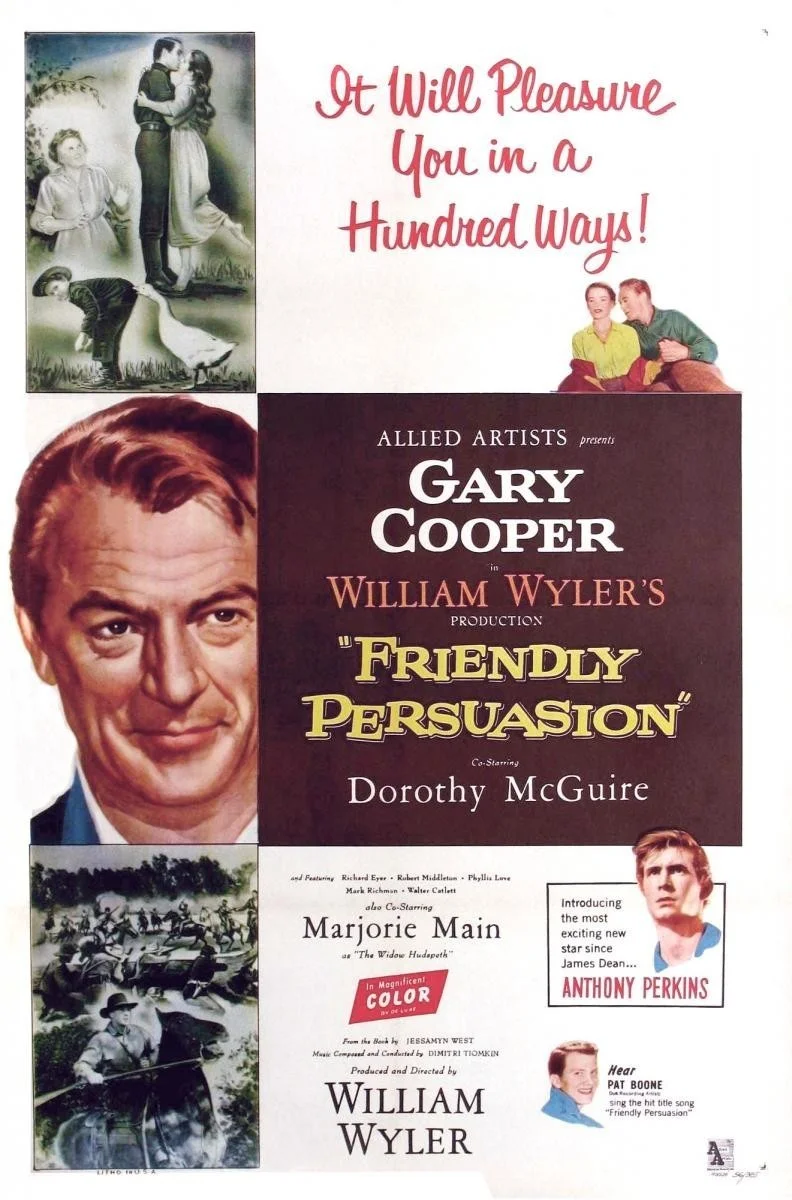
Friendly Persuasion*
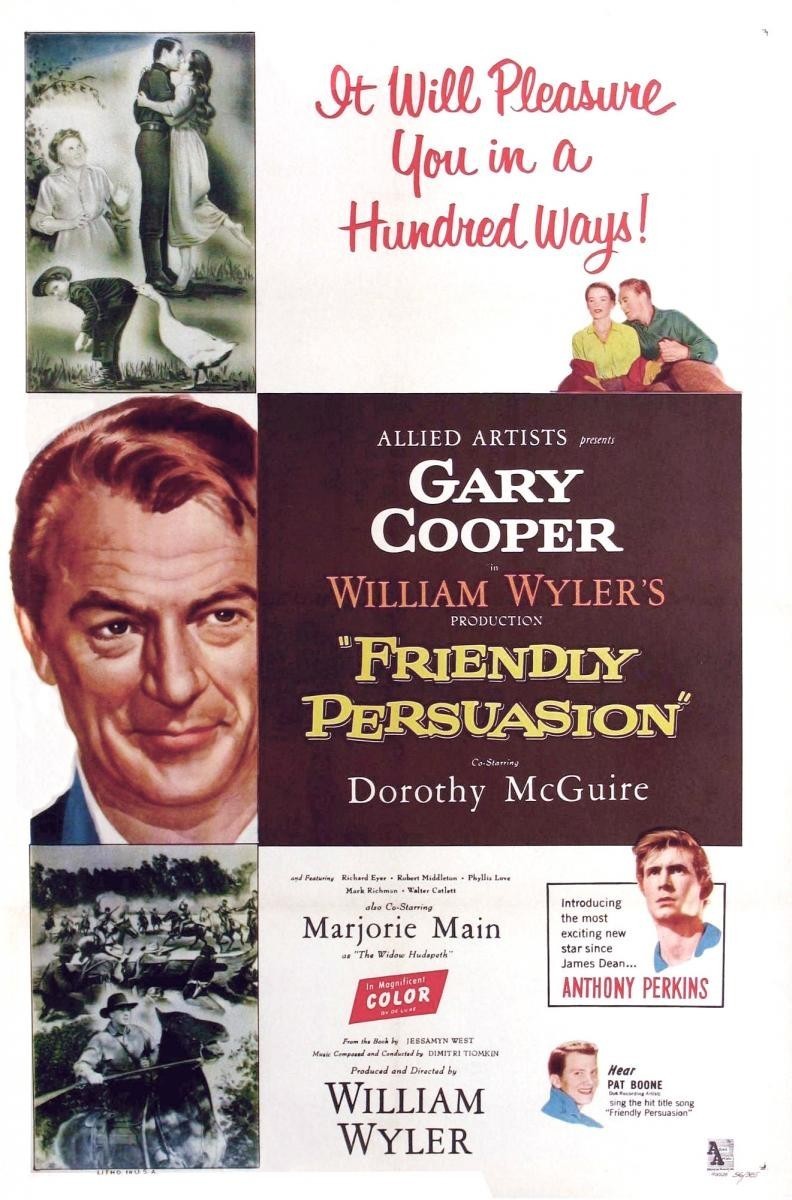
Friendly Persuasion
Directed by William Wyler. 137 mins. (1956)
Gary Cooper – Jess Birdwell
In a close-knit Indiana Quaker community during the Civil War, gentle farmer Jess Birdwell and his family strive to uphold their pacifist faith amid mounting national conflict—until the arrival of Confederate forces forces them to confront the limits of conscience, courage, and nonviolence.
Also starring Dorothy McGuire, Anthony Perkins, Richard Eyer, Robert Middleton, and Phyllis Love.
Adapted from the novel by Jessamyn West, the film explores the moral tensions between spiritual conviction and worldly duty. A critical and popular success, it earned six Academy Award nominations and the Palme d’Or at the Cannes Film Festival. President Ronald Reagan later cited it as his favorite film, presenting a VHS copy to Soviet leader Mikhail Gorbachev during the 1988 summit.
MARIA’S NOTES
Friendly Persuasion is a film my father, Gary Cooper, was not at all sure he should do because it would have been the first time his role was as a father and he strongly questioned the wisdom of that as a career choice. The wonderful Director William Wyler, had wanted to do this picture for years with Cooper but had to postpone making it because previous film commitments made my father unavailable. Thank goodness they finally got together.
The Wylers and the Coopers were friends and the chance to work together made my father very happy. The story itself was written by Jessamyn West but the writer for the script was Michael Wilson. This was a resonance to a darker time in Hollywood when Michael Wilson’s name was withheld from the credits because the studio chose, “their right to deny credit to a writer who had been accused of being a member of the Communist Party or refused to answer charges of Communist affiliations.” Wilson had invoked the 5th Amendment when summoned to be a witness by the House Un-American Activities Committee in 1951. This script was even nominated for an Academy Award for Best Adaptation but was judged ineligible! It’s quite an irony this story actually was based on an article written by a cousin of President Richard Nixon about their great great-grandparents – how strange – a pacifist screenplay written by a blacklisted writer about the ancestors of President Nixon.
The beautiful music score was composed by the Academy Award winning composer of High Noon, Dimitri Tiomkin. My father loved the music for the film and went around the house humming the theme song Thee I Love. The studio never asked Gary Cooper to sing it, they got Pat Boone instead and tried my father out on a song called Marry Me, Marry Me about which he said, “I hope all of this won’t ruin my career!”
It is interesting that this film along with Sergeant York and High Noon has as part of its essence a person’s conflict between civic and religious duty and how the lead character handles those decisions. In preparing for his role as Jess Birdwell, the head of a Quaker family, Jessamyn West took my father to several Quaker meetings so that he would have the experience of the fervor and simplicity of the meetings and get to know some members of the congregation. I remember my father saying, “I really like going to those meetings, they are still and they are quiet. I like being with them.” My father was asked how he felt about his role in the film and he answered with a smile, “Well, I played a backsliding Quaker.”
His eldest son, played by Anthony Perkins, is a young man again dealing with a conflict of conscience versus religious conviction and in the film they have a very touching relationship. One day my mother and I visited the set when they were filming a country fair. In a perhaps prescient moment, considering my 53-year long marriage to the world renowned concert pianist Byron Janis, my father went to one of the booths where there was a wonderful glass blower and after about a half hour he presented me with a box with 2 intricately designed glass figures – a concert piano and a man sitting playing it!
Maria Cooper Janis