
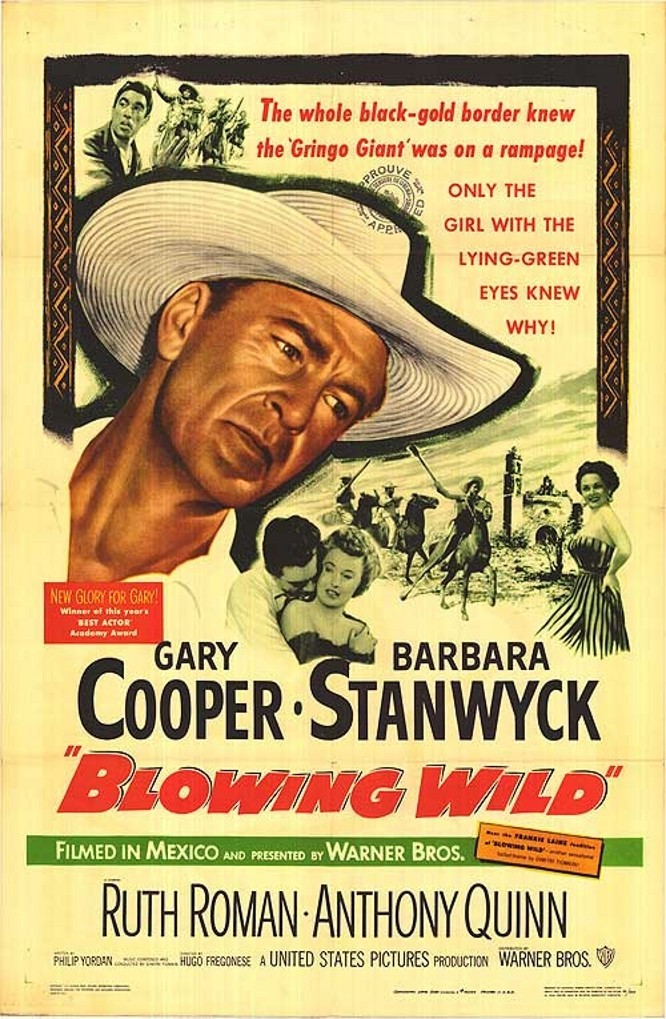
Blowing Wild
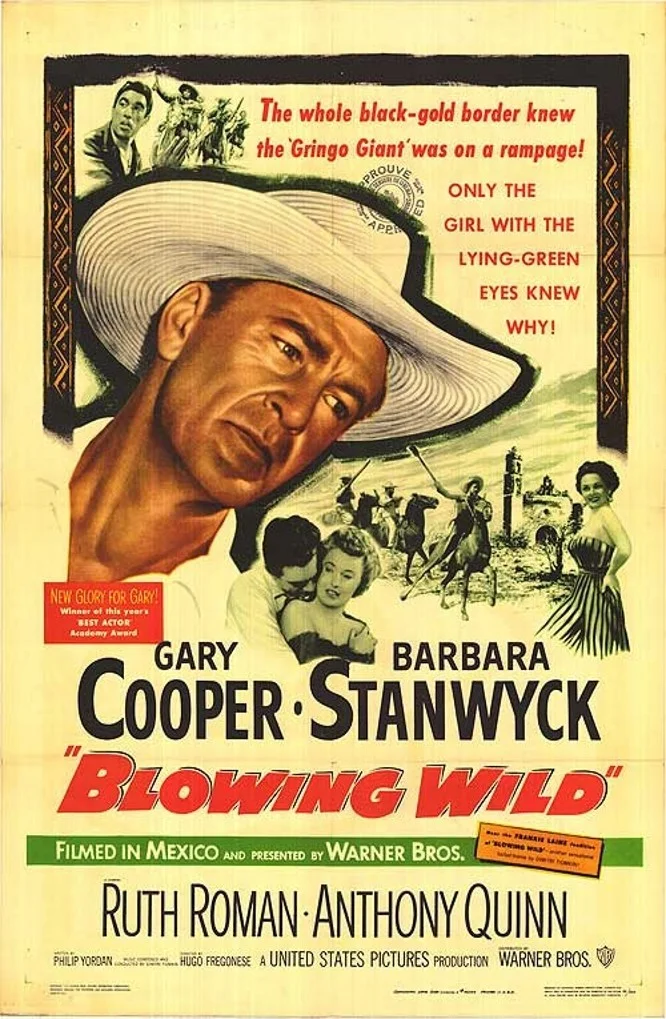
Blowing Wild
Directed by Hugo Fregonese. 89 mins. (1953)
Gary Cooper – Jeff Dawson
Two American oilmen struggling to survive in bandit-plagued South America risk their lives transporting unstable nitroglycerin across treacherous terrain, where greed, rivalry and a dangerous woman threaten to destroy their partnership.
Also starring Barbara Stanwyck, Ruth Roman, Anthony Quinn and Ward Bond.
During filming, Gary Cooper received the Academy Award for High Noon, while co-star Anthony Quinn won his first Oscar for Viva Zapata!.
Beau Sabreur
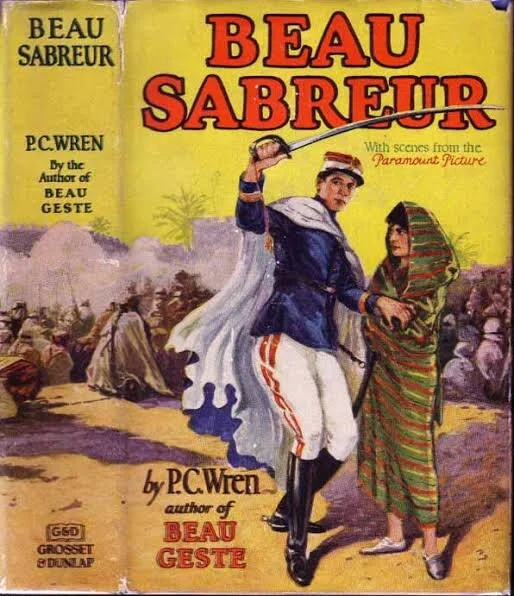
Beau Sabreur
Directed by John Waters. 70 mins. (1928)
Gary Cooper – Maj. Henri de Beaujolais
A loyal officer of the French Foreign Legion uncovers treachery within the ranks and undertakes a perilous mission across the desert to secure a fragile peace—risking his life and honor in a volatile land.
Also starring Evelyn Brent, Noah Beery, William Powell, Roscoe Karns and Mitchell Lewis.
Based on the novel Beau Sabreur by P. C. Wren, a companion story to Beau Geste. Actors Noah Beery and William Powell, who died in Beau Geste, return here in different roles.
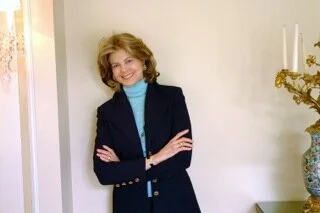
Maria Cooper Janis
Maria Cooper Janis was born in Los Angeles, California and lived there with her parents, the actor Gary Cooper and his wife Veronica Cooper.
She followed a painting career in New York and in 1966 married the world renowned concert pianist, Byron Janis. Although Mr. Janis’ busy schedule has led them all over the world, Mrs. Janis has enjoyed a successful career as an artist. She pursues her paintings with great energy, exhibiting in the United States as well as Europe and Asia.
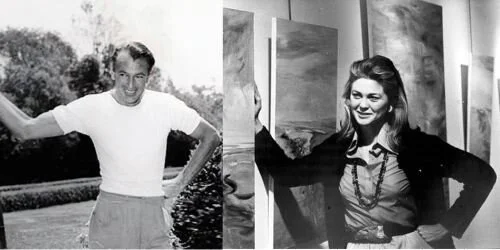
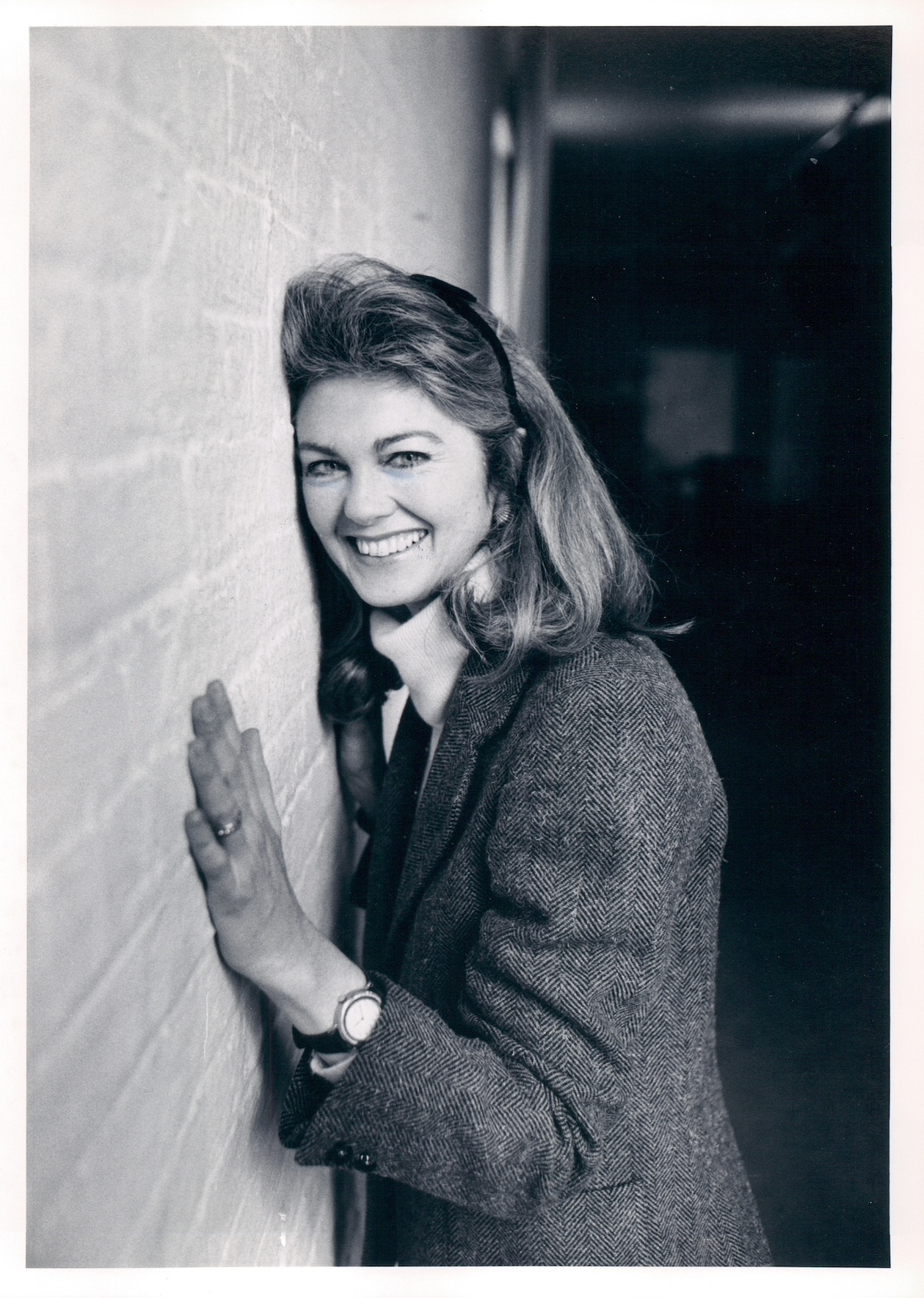
Maria Cooper Janis was born in Los Angeles, California and lived there with her parents, the actor Gary Cooper and his wife Veronica Cooper.
She followed a painting career in New York and in 1966 married the world renowned concert pianist, Byron Janis. Although Mr. Janis’ busy schedule has led them all over the world, Mrs. Janis has enjoyed a successful career as an artist. She pursues her paintings with great energy, exhibiting in the United States as well as Europe and Asia.
Maria Cooper Janis is involved with the American Arthritis Foundation of which her husband, Byron Janis is the National Spokesperson and she sits on the board of Pro Musicis, an organization committed to furthering the careers of young musicians. She also works with the Neuropathy Foundation and is an active board member of the ASPR (American Society for Psychical Research).
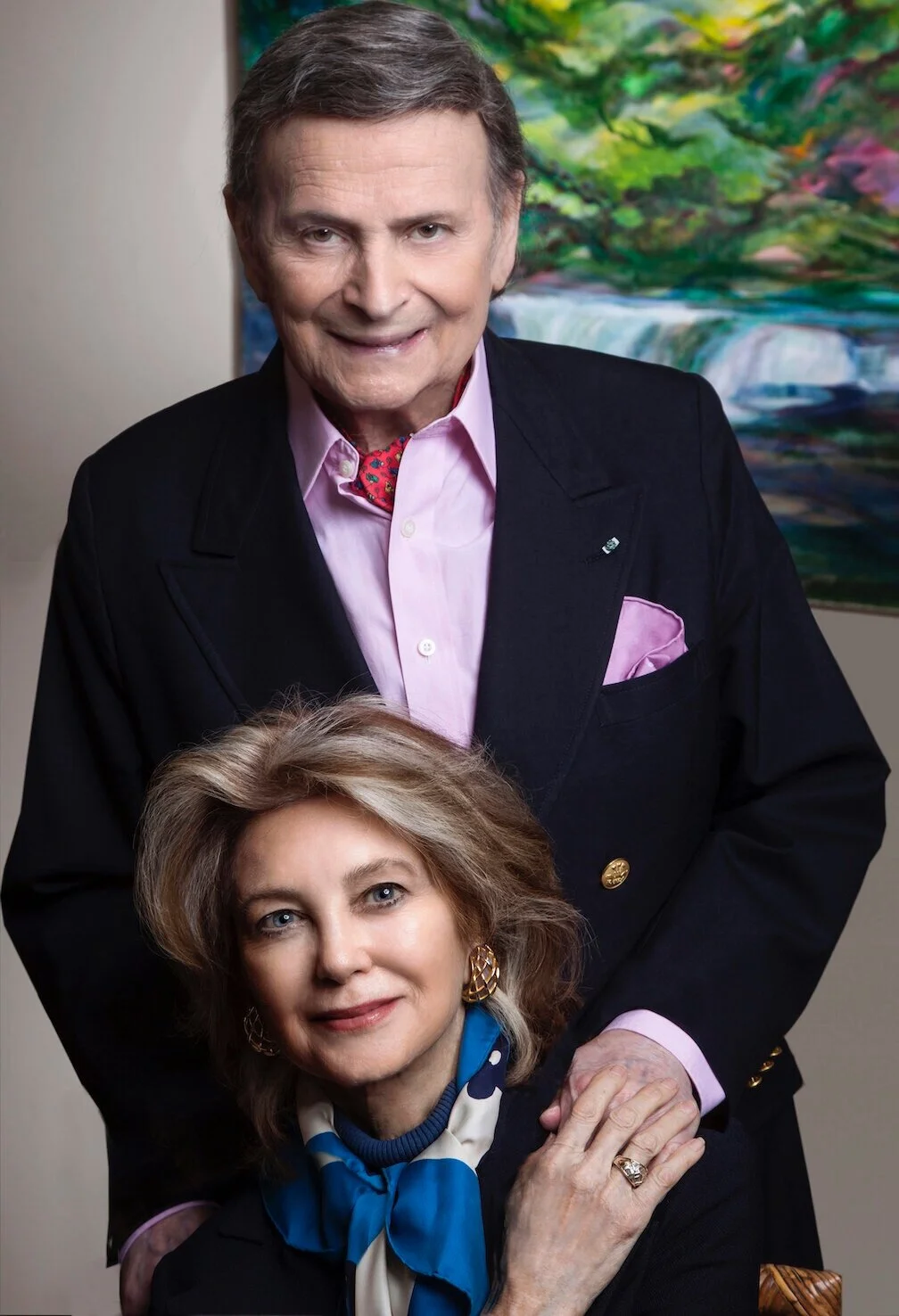
She has collaborated on three television specials, one produced by TNT “Gary Cooper, American Life, American Legend,” another, part of TNT’s Biography Series entitled “The Life and Times of Gary Cooper” and she has worked with A&E to contribute to a special on her father for their Biography program titled, “Gary Cooper: The Face of a Hero” which was aired in March of 1998. She has collaborated abroad with a PBS/French production of “Frederick Chopin: A Voyage with Byron Janis.” Mrs. Janis frequently lectures around the country on such topics as, “Growing Up in Hollywood” often with her longtime friend Joan Benny and Foster Hirsch.
She has written a book Gary Cooper off Camera: A Daughter Remembers which gives an inside look into the persona of one of the greatest movie stars of all time. Now 100% of the proceeds of the sales of this book are donated to The Gary Cooper Endowed Support Fund for Indigenous Cultures at The University of Southern California, School of Cinematic Arts. She has collaborated with author Bruce Boyer on Gary Cooper Enduring Style, published in November of 2011 by PowerHouse Books with an introduction by Ralph Lauren.
Maria Cooper Janis worked on a feature film documentary, “The True Gen,” about the special 20-year friendship between Gary Cooper and Ernest Hemingway, the score of which is composed by Byron Janis. In addition She co-produced the PBS documentary produced by Peter Rosen, The Byron Janis Story, about the life of Byron Janis which is currently being aired nationally and contributed to his autobiography, Chopin and Beyond: My Extraordinary Life in Music and the Paranormal.
Her artwork was used for CD, Album cover and limited edition liner note posters for three very special releases Byron Janis, Plays Chopin, Byron Janis, Live on Tour, Volume 1, Byro Janis, Live from Leningrad, the sketches were taken from her collection of work will she traveled on the road with her husband while he was appearing around the world. They can be found on byronjanislive.com, autographed and in limited quantities.
Before the pandemic, Maria and her trusted team archived the entire collection she has preserved and cherished from her Father, Mother, Fans and her own life including the Gary Cooper Papers, personal effects, correspondence, family movies and other incredible treasures to launch an exhibition at The University of Southern California, School of Cinematic Arts now rescheduled for April, 2022
In addition to film projects, she continues her work as a painter and also works with Indigenous Culture interests, something that was very close to her father’s heart, and has started the Gary Cooper Scholarship for American Indian Students in Film and Television at the USC School of Cinematic Arts.
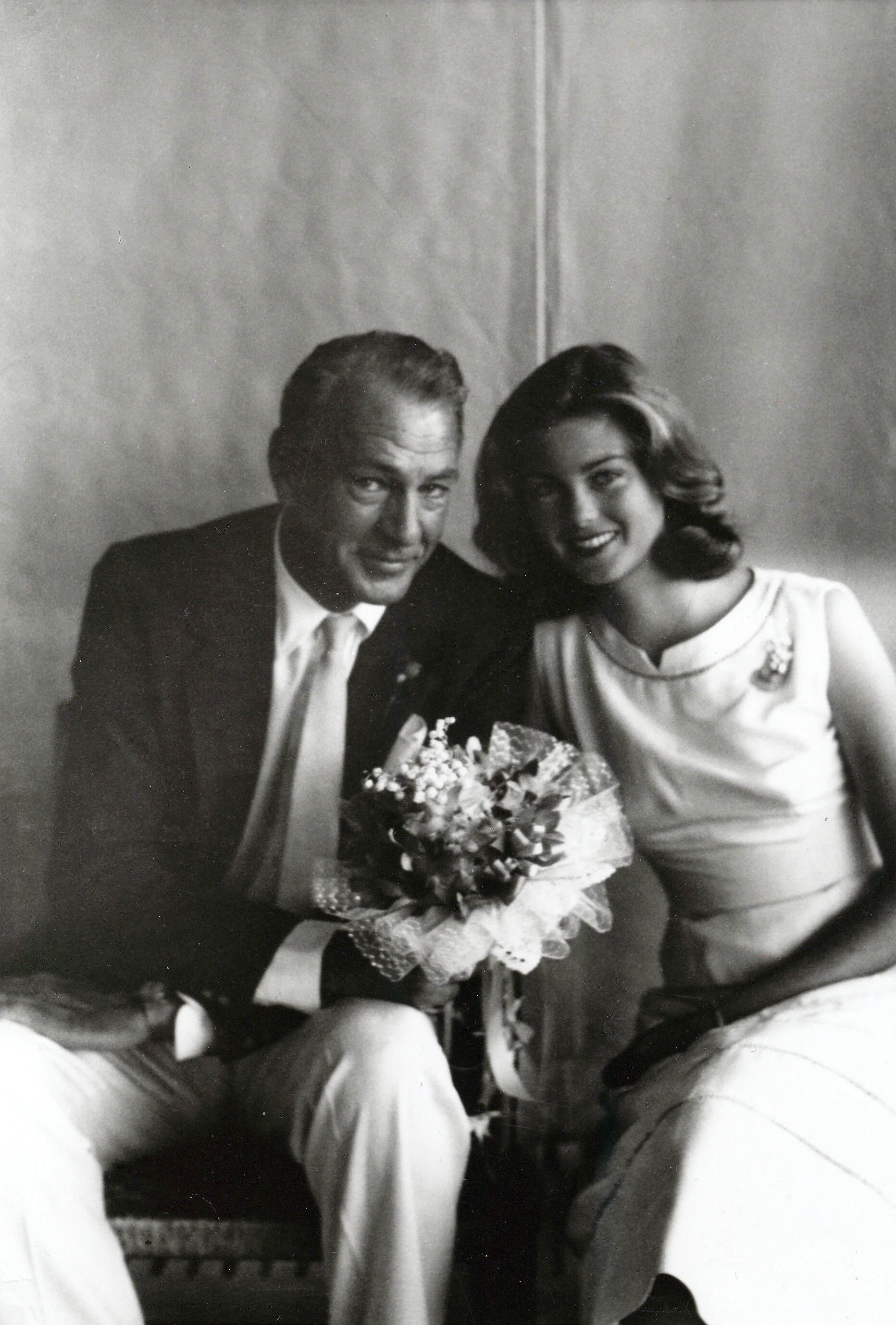
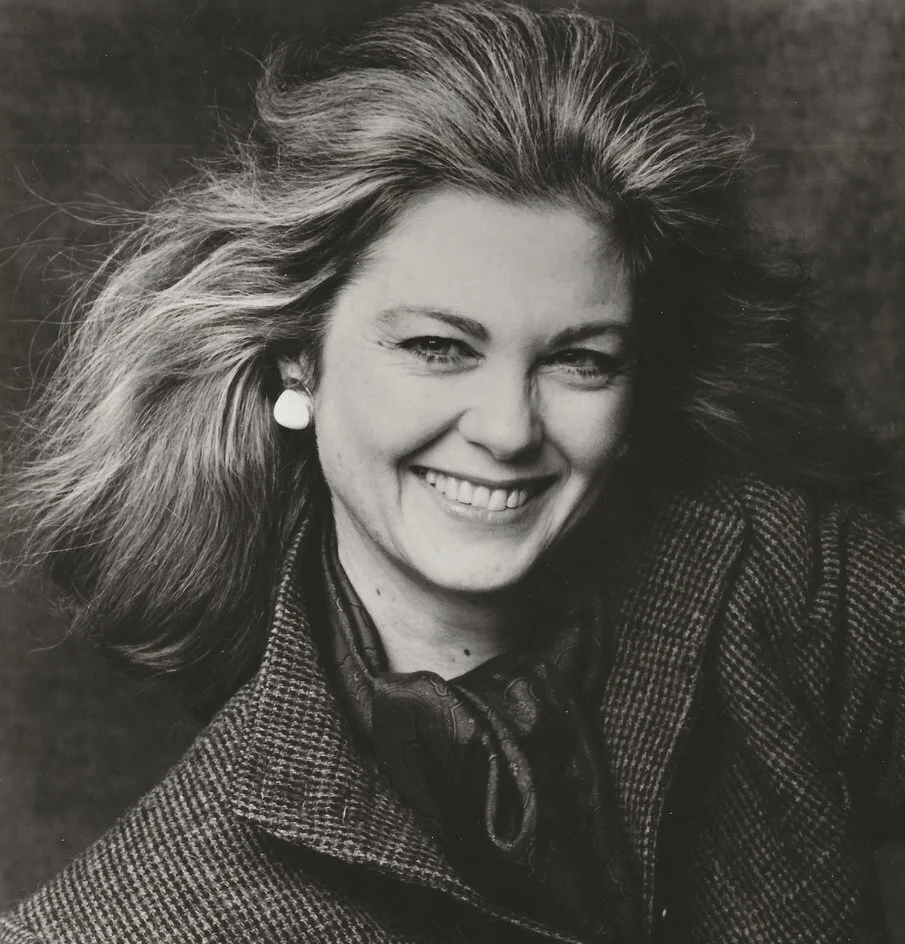
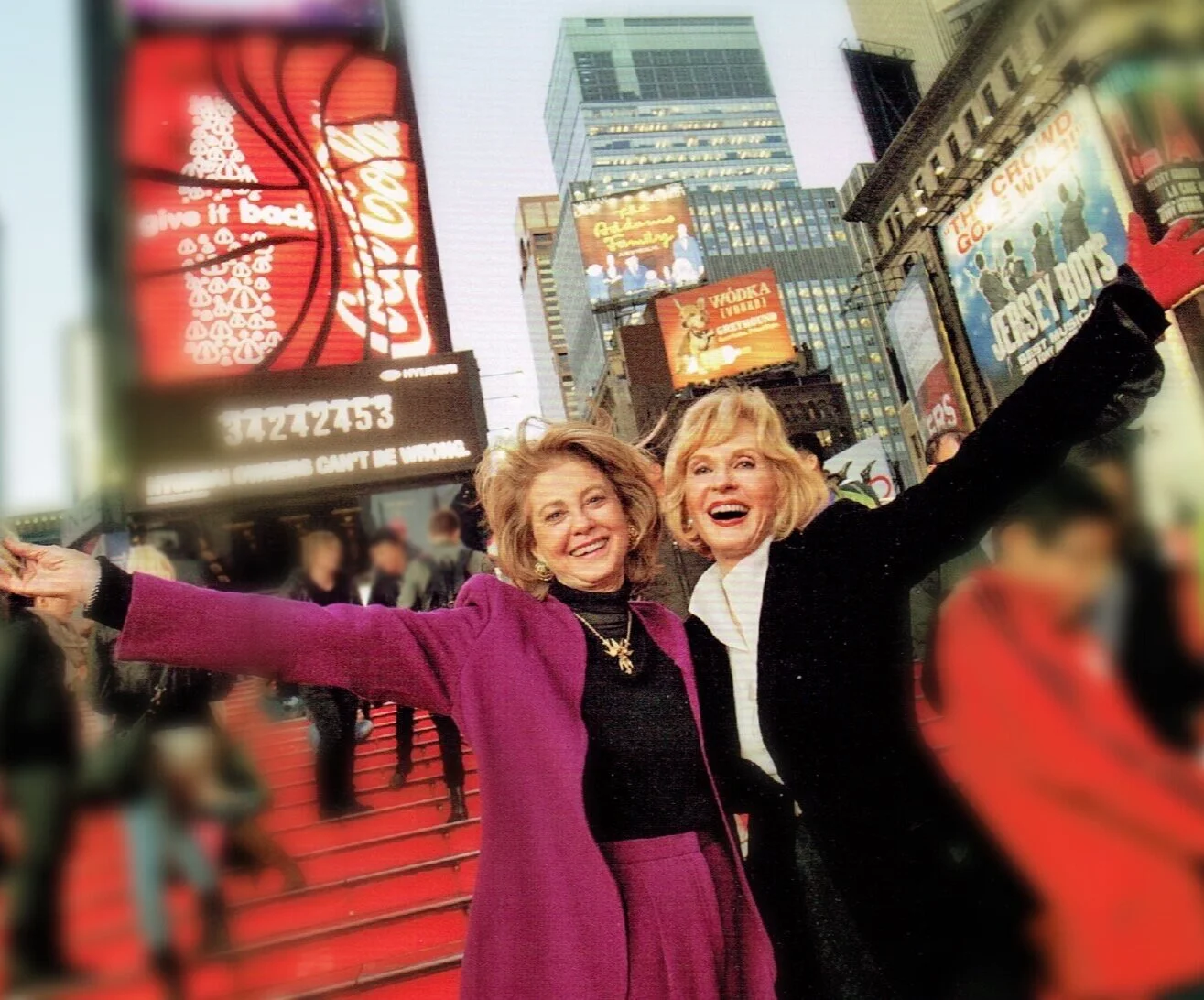
Lifelong pals Maria Cooper Janis and Pia Lindström in Times Square.
Maria is the daughter of Gary Cooper and wife of concert pianist Byron Janis. Pia is the daughter of Ingrid Bergman and wife of attorney John Carley.
New York City, 2010.
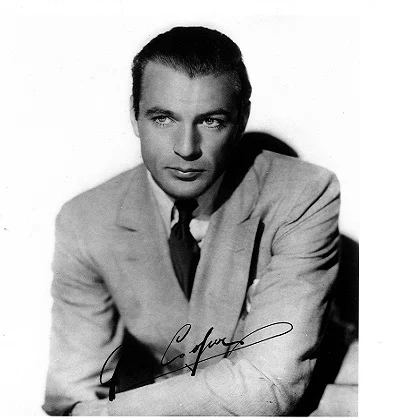
Gary Cooper
Gary Cooper was born Frank James Cooper in Helena, Montana, one of two sons of an English farmer from Bedfordshire, who later became an American lawyer and judge, Charles Henry Cooper (1865-1946), and Kent-born Alice (née Brazier) Cooper (1873-1967). His mother hoped for their two sons to receive a better education than that available in Montana and arranged for the boys to attend Dunstable Grammar School in Bedfordshire, England between 1910 and 1913.Upon the outbreak of World War I, Cooper’s mother brought her sons home and enrolled them in a Bozeman, Montana, high school

2005: The Gary Cooper Endowed Support Fund is established at the University of Southern California, School of Cinematic Arts
2016: Cartier Reopens their new Maison on 5th Avenue in New York, featuring Iconic Gary Cooper Photos in the new watch room and throughout the Maison with his signature Cartier Tank Watch
2017: The Film Forum, hosts a Screening of High Noon with a Panel led by Foster Hirsch with Maria Cooper Janis and Glenn Frankel introducing his new book, HIGH NOON – THE HOLLYWOOD BLACKLIST AND THE MAKING OF AN AMERICAN CLASSIC
2018: Maria Cooper Janis records the oral history of her father now a permanent installation at the new Academy Museum of Motion Pictures
2019: The Cooper archives and personal treasures are donated to USC for an Exhibition and Screening Delayed due to COVID
2021: Gary Cooper's Likeness and Image is featured in Current Films & Television Shows
2022: April will kick off a special screening and a six month Gary Cooper Exhibition at USC
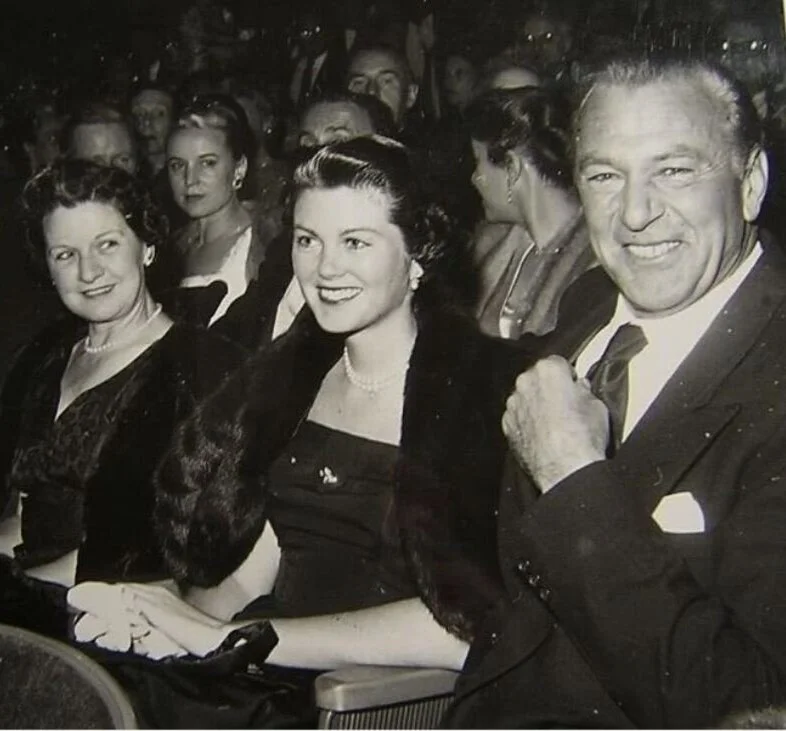
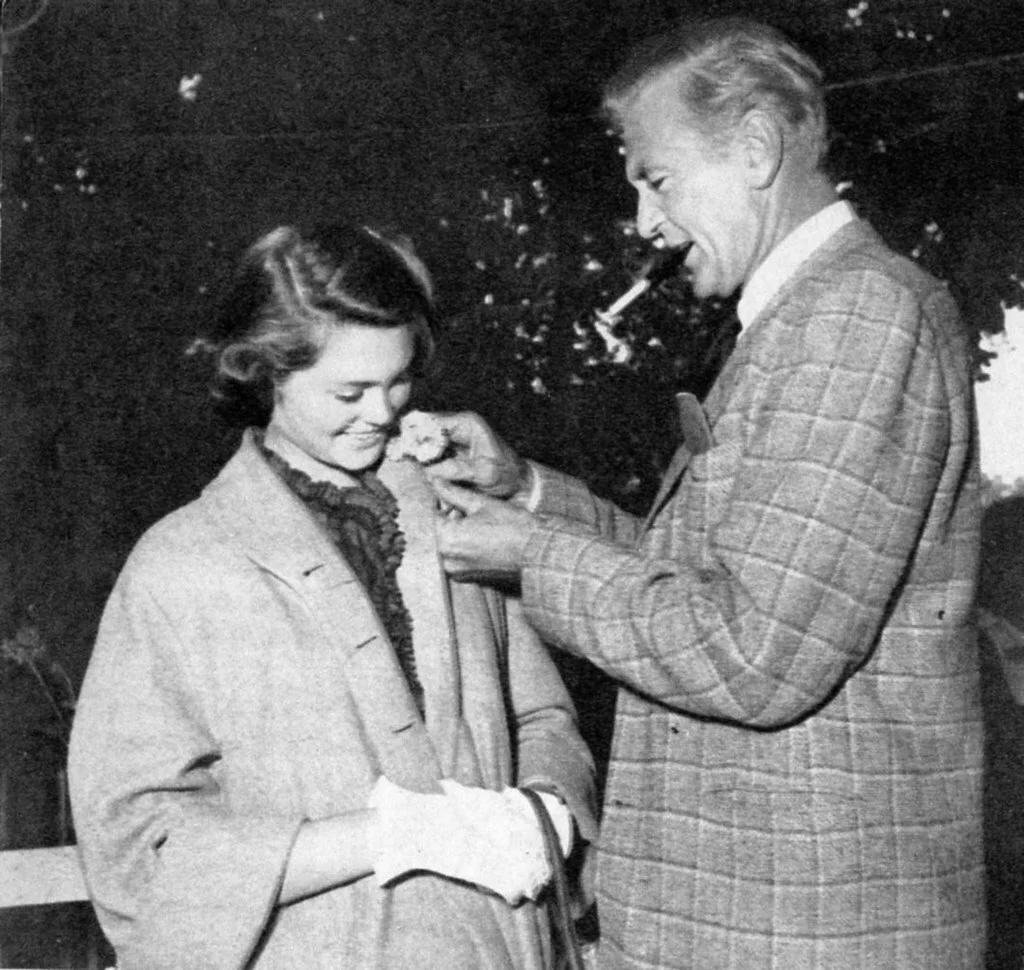
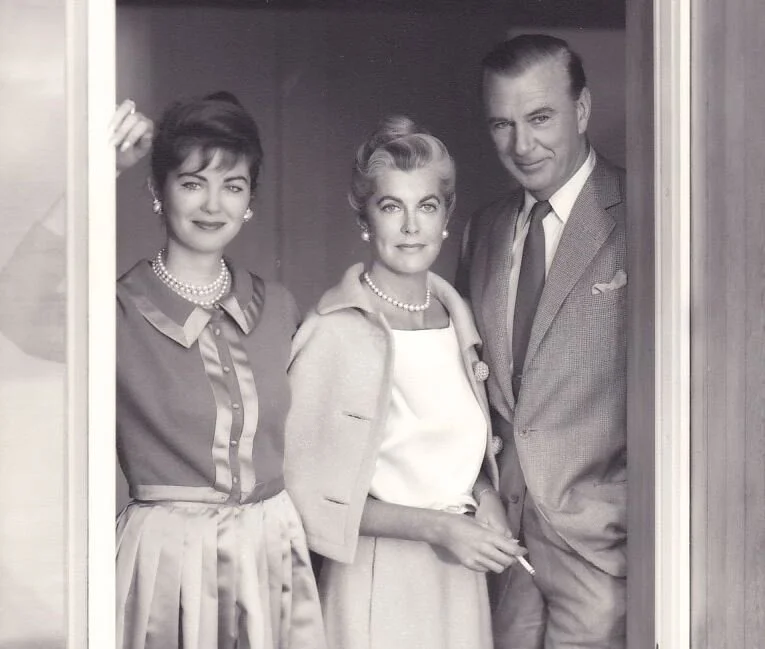
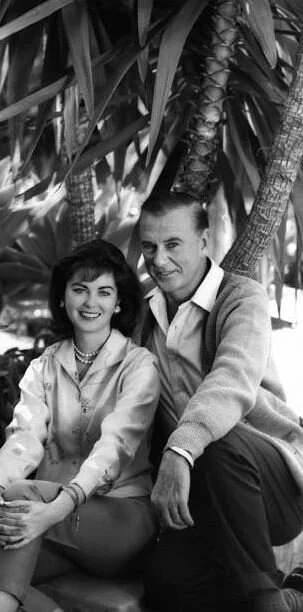
Gary Cooper was born Frank James Cooper in Helena, Montana, one of two sons of an English farmer from Bedfordshire, who later became an American lawyer and judge, Charles Henry Cooper (1865-1946), and Kent-born Alice (née Brazier) Cooper (1873-1967). His mother hoped for their two sons to receive a better education than that available in Montana and arranged for the boys to attend Dunstable Grammar School in Bedfordshire, England between 1910 and 1913.Upon the outbreak of World War I, Cooper’s mother brought her sons home and enrolled them in a Bozeman, Montana, high school.
When Cooper was 13, he injured his hip in a car accident. He returned to his parents’ ranch near Helena to recuperate by horseback riding at the recommendation of his doctor. Cooper studied at Iowa’s Grinnell College until the spring of 1924, but did not graduate. He had tried out, unsuccessfully, for the college’s drama club. He returned to Helena, managing the ranch and contributing cartoons to the local newspaper. In 1924, Cooper’s father left the Montana Supreme Court bench and moved with his wife to Los Angeles. Their son, unable to make a living as an editorial cartoonist in Helena, joined them, moving there that same year, reasoning that he “would rather starve where it was warm, than to starve and freeze too.”
Failing as a salesman of electric signs and theatrical curtains, as a promoter for a local photographer and as an applicant for newspaper work in Los Angeles, Cooper found work as an actor in 1925. He earned money as an “extra” in the motion picture industry, usually cast as a cowboy. He is known to have had an uncredited role in the 1925 Tom Mix Western, Dick Turpin. The following year, he had screen credit in a two-reeler, Lightnin’ Wins, with actress Eileen Sedgwick as his leading lady.
After the release of this short film, Cooper accepted a long-term contract with Paramount Pictures. He changed his name to Gary in 1925, following the advice of casting director Nan Collins, who felt it evoked the “rough, tough” nature of her native Gary, Indiana.
“Coop,” as he was called by his peers, went on to appear in over 100 films. Cooper broke through in a supporting role in Wings (1927), the only silent film to win an Academy Award for Best Picture, following that with Nevada (1927) co-starring Thelma Todd and William Powell, based on the Zane Gray novel, which was remade in 1944 as an early Robert Mitchum vehicle, the only time Cooper and Mitchum played the same role. He became a major star with his first sound picture, The Virginian (1929) opposite Walter Huston as the villainous Trampas. The Spoilers appeared the following year with Betty Compson, which was remade in 1942 with Compson lookalike Marlene Dietrich and John Wayne in Cooper’s role. Cooper followed this action movie with his own Dietrich film entitled Morocco (1930) in which he played a Foreign Legionnaire. Devil and the Deep (1932) featured Cary Grant in a supporting role with Talullah Bankhead and Cooper in the leads alongside Charles Laughton. The following year, Cooper was the second lead in the sophisticated Ernst Lubitsch comedy production of Noël Coward’s Design for Living, billed under Fredric March in the kind of fast-talking role Cooper never played again after Cary Grant staked out the light comedy leading man field with his persona-changing The Awful Truth four years later. The screen adaptation of A Farewell to Arms (1932), directed by Frank Borzage, and the title role in Frank Capra’s Mr. Deeds Goes to Town (1936) furthered Cooper’s box office appeal.
Cooper was producer David O. Selznick’s first choice for the role of Rhett Butler in the 1939 film Gone with the Wind. When Cooper turned down the role, he was passionately against it. He is quoted as saying, “Gone with the Wind is going to be the biggest flop in Hollywood history. I’m glad it’ll be Clark Gable who’s falling flat on his nose, not me”.Alfred Hitchcock wanted him to star in Foreign Correspondent (1940) and Saboteur (1942). Cooper later admitted he had made a “mistake” in turning down the director. For the former film, Hitchcock cast look-alike Joel McCrea instead.
Cooper cemented his cowboy credentials again in The Westerner (1940) opposite Walter Brennan as Judge Roy Bean and followed that immediately afterward with the lavish North West Mounted Police (1940), directed by Cecil B. DeMille and featuring Paulette Goddard.
In 1942, Cooper won his first Academy Award for Best Actor for his performance as the title character in Sergeant York. Alvin York refused to authorize a movie about his life unless Cooper portrayed him. Meet John Doe was released earlier the same year, a smash hit under the direction of Frank Capra. Ingrid Bergman had just made Casablanca when she and Cooper collaborated on For Whom the Bell Tolls (1943), based on a novel by Cooper’s close friend Ernest Hemingway. As a change of pace, he made a Western comedy lampooning his hesitant speech and mannerisms and his own image in general called Along Came Jones (1945) in which he relied on gunslinging Loretta Young to save him when the chips were down. Cooper also starred in the original version of the Ayn Rand novel The Fountainhead (1949) with Patricia Neal.
In 1953, Cooper won his second Best Actor Academy Award for his performance as Marshal Will Kane in High Noon, arguably considered his finest role. Ill with an ulcer, he wasn’t present to receive his Academy Award in February 1953. He asked John Wayne to accept it on his behalf, a bit of irony in light of Wayne’s stated distaste for the film.
Cooper continued to play the lead in films almost to the end of his life. Among his later box office hits were the stark Western adventure Garden of Evil (1954) with Susan Hayward and Richard Widmark; Vera Cruz (1954), an extremely influential Western in which he guns down villain Burt Lancaster in a showdown; his portrayal of a Quaker farmer during the American Civil War in William Wyler’s Friendly Persuasion (1956); and Anthony Mann’s Man of the West (1958), a hard-edged action Western with Lee J. Cobb. His final motion picture was a British film, The Naked Edge (1961), directed by Michael Anderson. Among his final projects was narrating an NBC documentary, The Real West, in which he helped clear up myths about famous Western figures.
On December 15, 1933, Cooper wed Veronica Balfe (May 27, 1913 – February 16, 2000), known as “Rocky.” Balfe was a New York Roman Catholic socialite who had briefly acted under the name of Sandra Shaw. She appeared in the film No Other Woman, but her most widely seen role was in King Kong, as the woman dropped by Kong. Her third and final film was Blood Money. Her father was governor of the New York Stock Exchange, and her uncle was motion-picture art director Cedric Gibbons. During the 1930s she also became the California state women’s skeet shooting champion. Cooper and Balfe had one child, Maria, now Maria Cooper Janis, married to classical pianist Byron Janis.
In April 1960, Cooper underwent surgery for prostate cancer after it had spread to his colon. It spread to his lungs and bones shortly thereafter.
Cooper was too ill to attend the Academy Awards ceremony in April 1961, so his close friend James Stewart accepted the honorary Oscar on his behalf. Stewart’s emotional speech hinted that something was seriously wrong, and the next day newspapers ran the headline, “Gary Cooper has cancer.” One month later, on May 13, 1961, six days after his 60th birthday, Cooper died.
Cooper was originally interred in Holy Cross Catholic Cemetery in Culver City, California. In May 1974 his body was removed from the Grotto Section of Holy Cross Cemetery, when his widow Veronica remarried and moved to New York, and she had Cooper’s body relocated to Sacred Heart Cemetery, in Southampton, New York, on Long Island. Veronica “Rocky” Cooper-Converse died in 2000 and was buried near Cooper at Sacred Heart Cemetery.
For his contribution to the film industry, Cooper has a star on the Hollywood Walk of Fame at 6243 Hollywood Blvd.
In 1966, he was inducted into the Western Performers Hall of Fame at the National Cowboy & Western Heritage Museum in Oklahoma City, Oklahoma.
In September 2009, Cooper was featured on a commemorative U.S. postage stamp.
He is mentioned numerous times in the HBO TV series The Sopranos as “the strong silent type” by Tony Soprano.
Cooper in Mr. Deeds Goes to Town with Jean Arthur (1936)
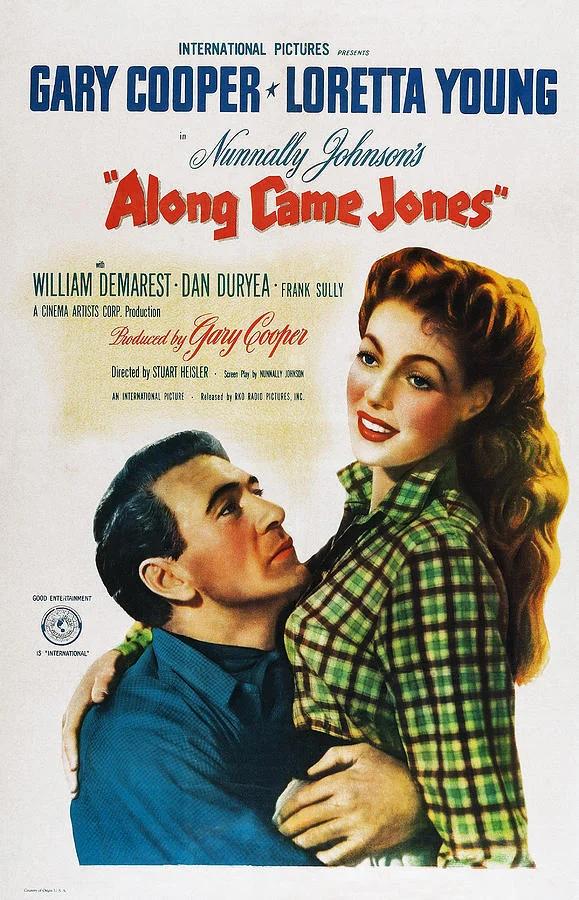
Along Came Jones*
Along Came Jones
Directed by Stuart Heisler. 90 mins. (1945)
Gary Cooper – Melody Jones
A mild-mannered saddle tramp drifts into a frontier town and is mistaken for a notorious outlaw, forcing him to play the part of a dangerous gunslinger while struggling to stay true to his gentle nature.
Also starring Loretta Young, William Demarest, Dan Duryea, and Frank Sully.
Gary Cooper’s first independent production through Cinema Artists Corp., and the only feature he produced during his career. In a playful twist on his screen image, Cooper gently parodies his own laconic cowboy persona.
MARIA’S NOTES
This film was my father’s first time wearing a Producer’s hat at the same time as acting in it. Judging by his personal comments about wearing 2 hats, I know he would be in huge admiration today for the multi-talented Clint Eastwood. My father hated being a Producer. Cooper portrays a character named Melody Jones, a quiet simple cowboy, who finds himself mistaken for a crook with the same initials, Monte Jared. Melody Jones does not even know how to handle a gun. He lives his life with humor, charm and naivete but his being mistaken for the outlaw changes the trajectory of his life as he tries to cope with having the same initials as the villain. His character lacked the skills of a typical Gary Cooper hero. Samuel Goldwyn chewed him out about that. Cooper kind of makes fun of the Western hero and Goldwyn said, “ You shouldn’t do that sort of thing – never play anything that lets the public down – your public.” The Producer Nunnally Johnson and my father got along very well even with some of the parody of the Western, Johnson said, “To me, Cooper was always The Western Man - eternally gallant, eternally defeated and the movie itself is one long bitter laugh at life.” But in the process, the picture gave Cooper a Saturday Evening Post cover painted by the great American illustrator Norman Rockwell. A special personal moment – my mother had given his saddle used in the film to the National Cowboy and Western Heritage Museum. It had carved into it in large letters the initials MJ for Melody Jones/Monty Jared. My husband Byron Janis and I were in Oklahoma City for a concert and we wanted to visit the museum and see where my father’s saddle was exhibited. So there I am standing next to his saddle with my current initial (Maria Janis) also represented! The saddle kind of leaped out at me saying a warm, “Hello.”
Maria Cooper Janis
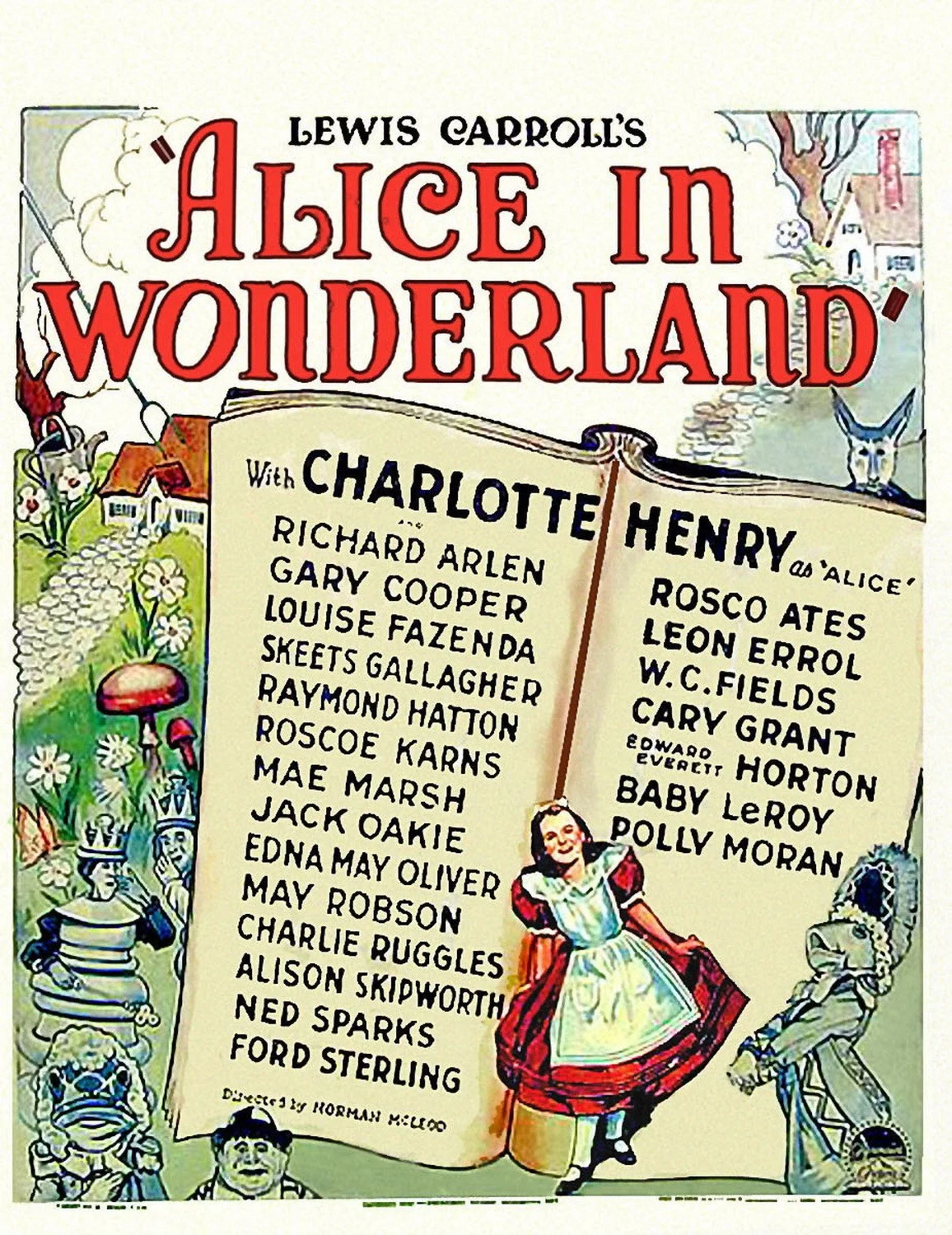
Alice in Wonderland
Alice in Wonderland
Directed by Norman Z. McLeod. 76 mins. (1933)
Gary Cooper – The White Knight
Young Alice escapes a dull winter afternoon by stepping through the looking glass into a fantastical dream world where logic dissolves, identities shift, and a procession of eccentric characters guide her through a surreal journey of wonder and absurdity.
Also starring Charlotte Henry, Richard Arlen, Roscoe Ates, William Austin, Leon Errol, and Cary Grant.
Paramount cast much of its contract star roster in elaborate costumes for this ambitious fantasy, hoping a spectacle of recognizable names would rescue the struggling studio. Audiences could scarcely identify the actors beneath their disguises, and it was ultimately Mae West’s She Done Him Wrong and I’m No Angel that restored Paramount’s fortunes.
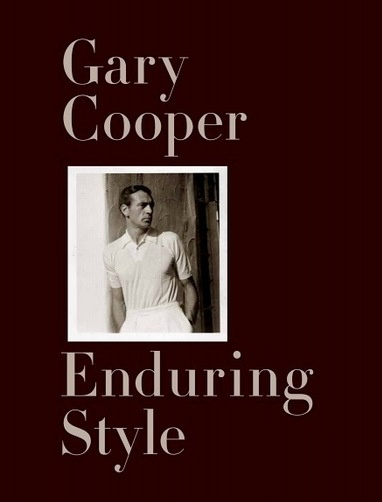
GARY COOPER ENDURING STYLE
by G. Bruce Boyer and Maria Cooper Janis
Design by Ruth Ansel
Introduction by Ralph Lauren
“Dressed up like a million-dollar trouper Tryin’ hard to look like Gary Cooper / Super duper” – “Puttin’ on the Ritz,” Irving Berlin (revised lyrics, 1946)
In 1946, when Irving Berlin revised the lyrics to his 1928 “Puttin’ on the Ritz” to include those memorable lines, Gary Cooper had been a star for over 15 years, and it would have been hard for most men to look as super duper. He conveyed a straightforwardness and an honest, American handsomeness that seemed to both ignore and rise above the contrived glamour and studied posturing that had characterized so many other film heroes of those early years. No matter what costume he put on, he looked like he owned it. The camera loved him, and so did the box office.
by G. Bruce Boyer and Maria Cooper Janis
Design by Ruth Ansel
Introduction by Ralph Lauren
“Dressed up like a million-dollar trouper Tryin’ hard to look like Gary Cooper / Super duper” – “Puttin’ on the Ritz,” Irving Berlin (revised lyrics, 1946)
In 1946, when Irving Berlin revised the lyrics to his 1928 “Puttin’ on the Ritz” to include those memorable lines, Gary Cooper had been a star for over 15 years, and it would have been hard for most men to look as super duper. He conveyed a straightforwardness and an honest, American handsomeness that seemed to both ignore and rise above the contrived glamour and studied posturing that had characterized so many other film heroes of those early years. No matter what costume he put on, he looked like he owned it. The camera loved him, and so did the box office.
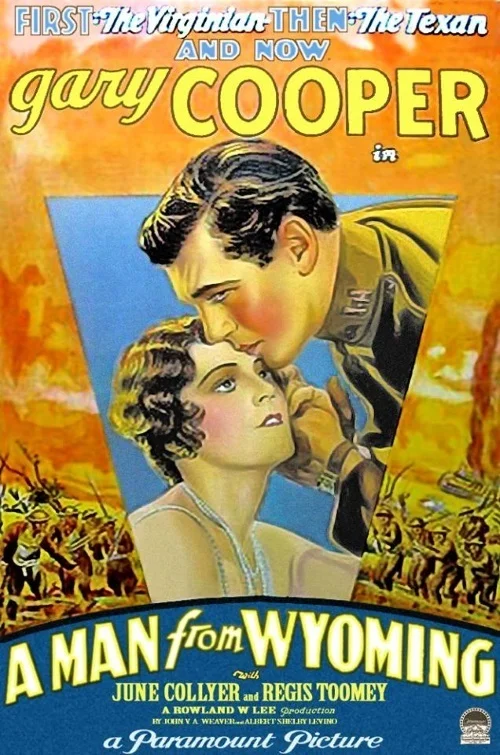
A Man From Wyoming
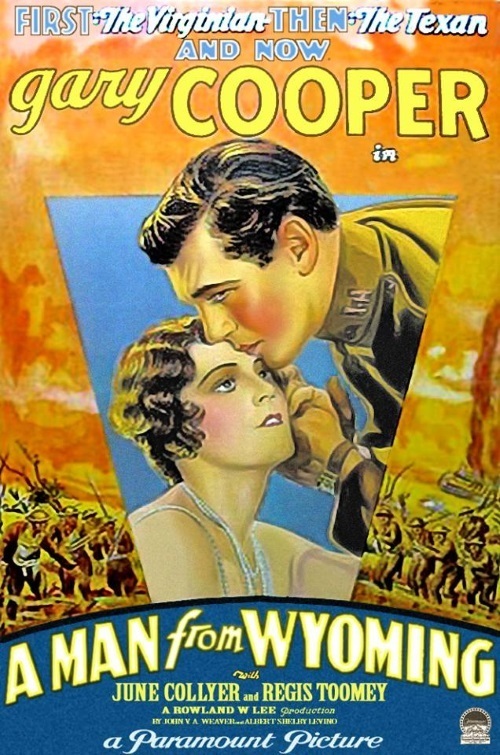
A Man from Wyoming
Directed by Rowland V. Lee. 70 mins. (1930)
Gary Cooper – Jim Baker
An American construction worker who eagerly enlists in World War I falls in love with a general’s spirited daughter on the front lines; when he is presumed dead, her reckless grief leads their lives onto divergent paths until an unexpected reunion forces them to confront love and loss.
Also starring June Collyer, Regis Toomey, Morgan Farley, E.H. Calvert and Mary Foy.
A wartime romantic drama set amid the trenches of World War I, the film reflects early-sound Hollywood’s fascination with sacrifice, heroism and the emotional toll of modern warfare.
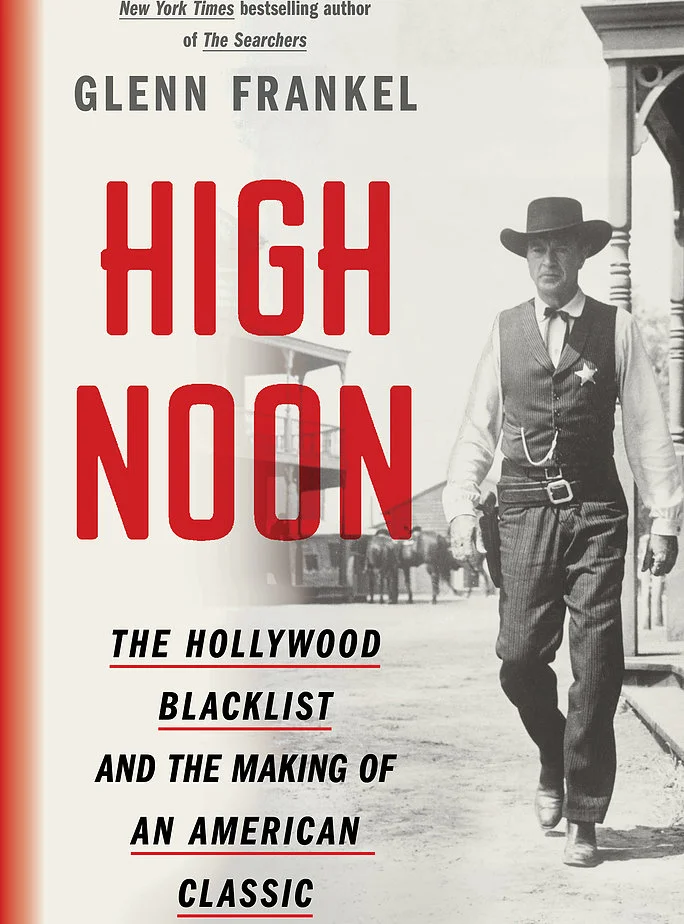
HIGH NOON – The Hollywood Blacklist and the Making of an American Classic
by Glenn Frankel
Book Release on February 21st: “HIGH NOON – The Hollywood Blacklist and the Making of an American Classic
It’s one of the most revered movies of Hollywood’s golden age. Starring screen legend Gary Cooper and Grace Kelly in her first significant movie role, High Noon achieved instant box-office and critical success. But what is often overlooked is that High Noon was made during the height of the Hollywood blacklist, a time of political inquisition and personal betrayal. In the middle of the film shoot, screenwriter Carl Foreman was called to testify about his former membership in the Communist Party, facing the painful dilemma of whether to name names or sacrifice his brilliant career. As he pondered what to do, Foreman turned his screenplay into a parable about fear, repression and the cost of courage.
by Glenn Frankel
Book Release on February 21st: “HIGH NOON – The Hollywood Blacklist and the Making of an American Classic
It’s one of the most revered movies of Hollywood’s golden age. Starring screen legend Gary Cooper and Grace Kelly in her first significant movie role, High Noon achieved instant box-office and critical success. But what is often overlooked is that High Noon was made during the height of the Hollywood blacklist, a time of political inquisition and personal betrayal. In the middle of the film shoot, screenwriter Carl Foreman was called to testify about his former membership in the Communist Party, facing the painful dilemma of whether to name names or sacrifice his brilliant career. As he pondered what to do, Foreman turned his screenplay into a parable about fear, repression and the cost of courage.
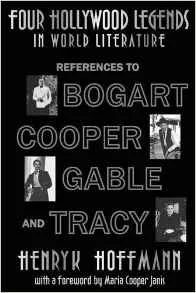
Four Hollywood Legends in World Literature: References to Bogart, Cooper, Gable and Tracy
by Henryk Hoffmann
Four Hollywood Legends in World Literature: References to Bogart, Cooper, Gable and Tracy
Henryk Hoffmann’s Four Hollywood Legends in World Literature: References to Bogart, Cooper, Gable and Tracy is an extraordinary resource, grounded in massive research and filled with insights about the way four iconic Hollywood figures have inspired and influenced an astonishing range of literary and creative works. In an interview, Hoffmann described the qualities that made Clark Gable, Humphrey Bogart, Gary Cooper, and Spencer Tracy uniquely influential, and the ways that their lives and their work were reflected in books by writers from Larry McMurtry to Elmore Leonard.
by Henryk Hoffmann
Four Hollywood Legends in World Literature: References to Bogart, Cooper, Gable and Tracy
Henryk Hoffmann’s Four Hollywood Legends in World Literature: References to Bogart, Cooper, Gable and Tracy is an extraordinary resource, grounded in massive research and filled with insights about the way four iconic Hollywood figures have inspired and influenced an astonishing range of literary and creative works. In an interview, Hoffmann described the qualities that made Clark Gable, Humphrey Bogart, Gary Cooper, and Spencer Tracy uniquely influential, and the ways that their lives and their work were reflected in books by writers from Larry McMurtry to Elmore Leonard.
LETTER FROM MARIA
MARIA COOPER JANIS, A PRODUCER, ACTRESS AND ARTIST IN HER OWN RIGHT. SHARES MEMORIES AND EVENTS OF HER LIFE WITH HER LEGENDARY FATHER
I do not think it is being prejudices to say that I find the premise and ideas behind Henryk Hoffman’s new book on Hollywood legends unique, fascinating, and very worthwhile-reading for the general public and film buffs alike. To put the body of an artist’s work in the context of not only his times, but the public tastes, to learn about his colleagues and the political forces that are acting all around him, is a stage that helps us understand more deeply the nature and scope of that person’s talents and artistic challenges. Bogart, Cooper, Gable, and Tracy are all great film names and legends, no doubt, and this unique approach to understanding and examining the professional lives of these actors, I feel, is refreshing and starts one thinking in more depth and about the impact of the people we designate “stars” or “legends.”
Gary Cooper’s screen persona and Gary Cooper the man, husband, father, the friend, were integrated into a seamless whole in his person – without artifice. I would like to share a quote from my father that illustrates his thinking:
“I don’t like to see exaggerated airs and exploding egos in people who are already established…No player ever rises to prominence solely on his or her extraordinary talent. Players are molded by forces other than themselves. They should remember this and at least twice a week drop down on their knees and thank Providence for elevating them from cow ranches, dime store ribbon counters, and bookkeeping desks.”
In addition to testifying to my father’s modesty and humility, this quotation proves that Gary Cooper, just like probably the other three actors, was not aware of his role as an idol, neither did he anticipate the impact that his films would have on future generations. Times have certainly changes and the movies of our different decades reflect that. It in quite unbelievable to learn, for instance, that in some circles, in its day, one of my father’s most-loved films, Mr. Deeds Goes to Town, was perceived to have “Communist leanings.”
It pleases me to see the wide range of my father’s work given an exploration via the interesting film synopses and excerpted texts from other authors and their books. In his film roles, he was certainly more than a “one trick pony”. For example, I have always felt his ability in the area of comedy roles was too much overlooked by both the studios and the public. Due to his versatility he was able to move easily from Western star to “dashing romantic leading man” to war hero to, as he would put it, “plain, average Joe American.”
It is also interesting to see how the various Gary Cooper characters in all the different films have evoked such emotional and creative responses in others and have found their way into authors’ minds and their own stories. It is like a “happy haunting” – this Cooper persona following these other creators, maybe challenging them or annoying them, whatever it is that keeps resonating then and now, some seventy years plus after the majority of Gary Cooper movies were made. The characters he portrayed seemed to get under people’s skin and provide a vehicle or jumping-off point for their own stories and imagination.
Clearly, as Mr. Hoffman illustrates, Gary Cooper became a metaphor in people’s minds. The film star in his various roles, it seems, somehow went deeper. The man himself, not the actor, but a simple and complex human being who always felt “dam lucky” for all the good breaks in life he had been given. To be relevant some fifty years after your career is finished is a testimony to some underlying basic principles. In the mega television series The Sopranos, even Tony Soprano refers to Gary Cooper as if he were talking through some of his life problems with his shrink! “High Noon” itself and Gary Cooper have become an absolute art of the lexicon in American writing. “To be high-nooned” is even given a definition referring to the film in the dictionary – Life imitates Art. Movies have a magical way of staying with the viewer long after the film has been seen. A mere few words enduringly tell the listener volumes “like Gary Cooper walking down the street in High Noon.” It evokes emotions and memories. No more need be said.
JOIN OUR E-MAIL LIST
SIGN UP FOR THE OFFICIAL MAILING LIST AND BE THE FIRST TO LEARN ABOUT NEW CONTENT, NEW FEATURES AND SPECIAL PROMOTIONS AND MORE
SIGN UP FOR THE OFFICIAL MAILING LIST AND BE THE FIRST TO LEARN ABOUT NEW CONTENT, NEW FEATURES AND SPECIAL PROMOTIONS AND MORE...
LICENSING INQUIRIES
IF YOU ARE INTERESTED IN CONTACTING THE ESTATE OF GARY COOPER ABOUT LICENSING OR PARTNERSHIP OPPORTUNITIES. PLEASE USE THE FORM PROVIDED
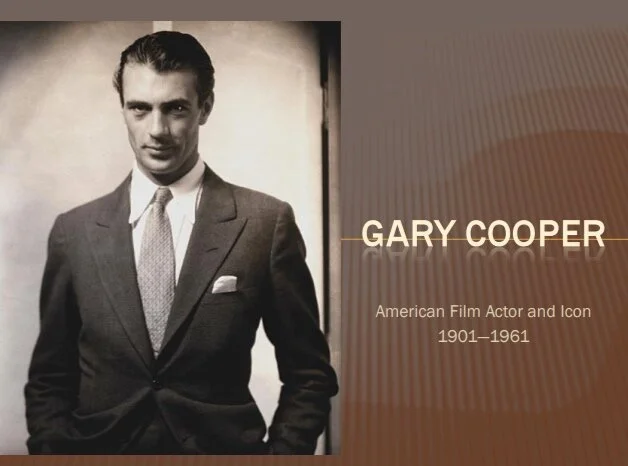
Gary Cooper, The Legacy
For appearances & Interviews with Maria Cooper Janis & Licensing Inquiries, please contact:
Bettina L Klinger
Email: bklinger@brandvarietal.com
Phone: 917-930-8654
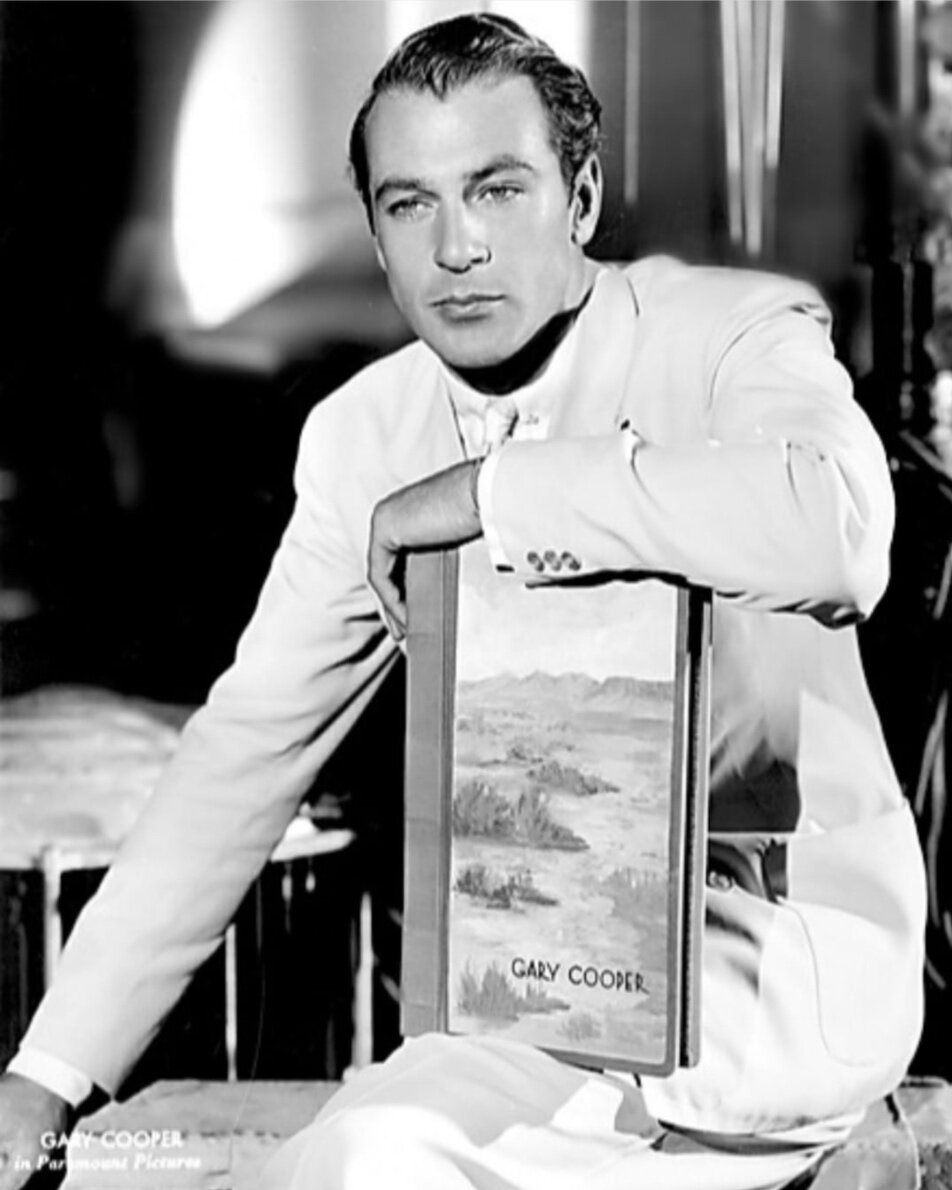
Gary Cooper, Elements of Style
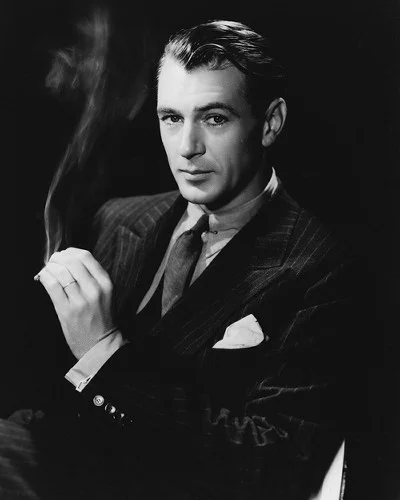
Gary Cooper, The Strong Silent Type
New "Gravity" tour dates posted
Maecenas sed diam eget risus varius blandit sit amet non magna. Duis mollis, est non commodo luctus, nisi erat porttitor ligula, eget lacinia odio sem nec elit.
Maecenas sed diam eget risus varius blandit sit amet non magna. Duis mollis, est non commodo luctus, nisi erat porttitor ligula, eget lacinia odio sem nec elit. Vivamus sagittis lacus vel augue laoreet rutrum faucibus dolor auctor. Donec ullamcorper nulla non metus auctor fringilla. Fusce dapibus, tellus ac cursus commodo, tortor mauris condimentum nibh, ut fermentum massa justo sit amet risus. Cras mattis consectetur purus sit amet fermentum. Maecenas faucibus mollis interdum.
Aenean eu leo quam. Pellentesque ornare sem lacinia quam venenatis vestibulum. Fusce dapibus, tellus ac cursus commodo, tortor mauris condimentum nibh, ut fermentum massa justo sit amet risus. Etiam porta sem malesuada magna mollis euismod. Praesent commodo cursus magna, vel scelerisque nisl consectetur et. Cras justo odio, dapibus ac facilisis in, egestas eget quam. Duis mollis, est non commodo luctus, nisi erat porttitor ligula, eget lacinia odio sem nec elit.
Cras mattis consectetur purus sit amet fermentum. Morbi leo risus, porta ac consectetur ac, vestibulum at eros. Aenean eu leo quam. Pellentesque ornare sem lacinia quam venenatis vestibulum. Cras mattis consectetur purus sit amet fermentum. Maecenas faucibus mollis interdum. Praesent commodo cursus magna, vel scelerisque nisl consectetur et.